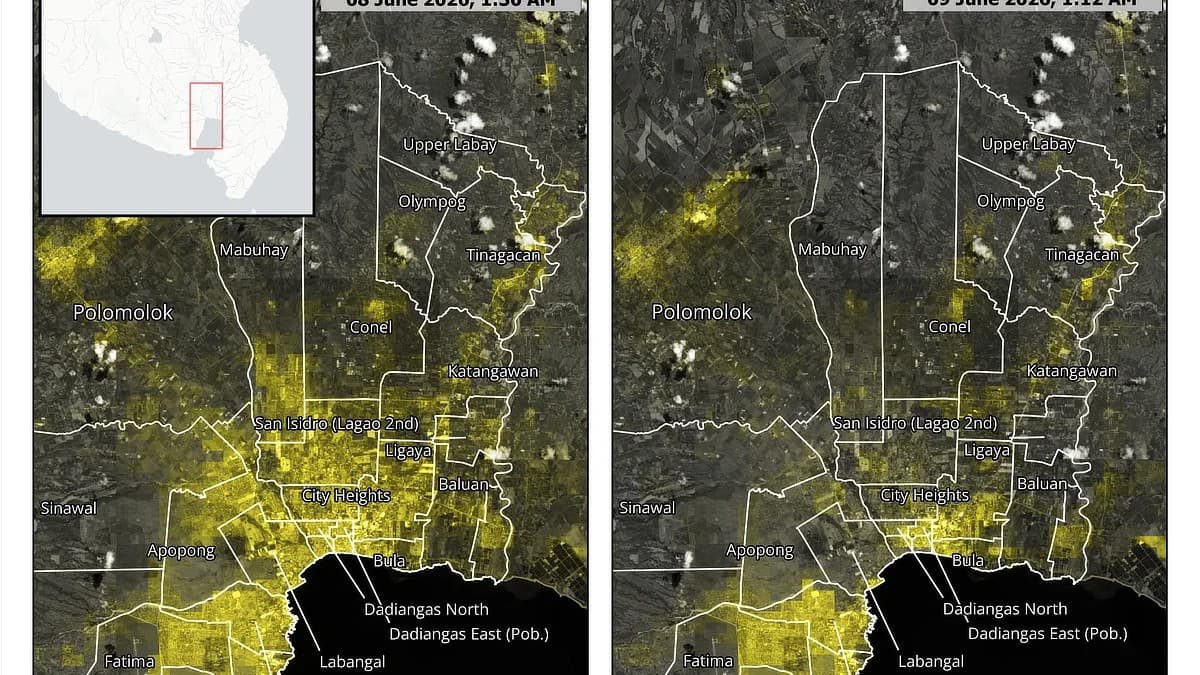
After a magnitude 7.8 earthquake struck offshore Sarangani on June 8, 2026, the Philippine Space Agency (PhilSA) turned to a rapid, wide-area assessment method that doesn't require ground teams to reach affected areas: nighttime satellite light analysis.
The Method
PhilSA compared satellite imagery captured at 1:30 AM on June 8 and 1:12 AM on June 9 — before and after the disaster — and mapped areas where nighttime illumination had significantly dropped. Changes in nighttime light serve as a proxy for power loss, infrastructure damage, or population displacement, allowing disaster managers to identify stricken zones quickly when roads and communications are compromised.
Areas Identified
The analysis flagged reduced illumination across several populated areas:
General Santos City (population 722,059): Barangays Labangal, Apopong, San Isidro, and City Heights, plus coastal barangays Siguel and Tambler.
Sarangani Province: Maasim (population approximately 67,907) and Glan (approximately 117,017).
South Cotabato: Polomolok (approximately 176,671 residents).
Support for Disaster Response
PhilSA said it will continue monitoring the affected areas as power and infrastructure are restored, using the return of nighttime light as a gauge of recovery progress. The data feeds into the National Disaster Risk Reduction and Management Council (NDRRMC) to help prioritize where ground teams and relief resources are most urgently needed.
Phivolcs separately warned that a higher-magnitude event remains possible in the same region — the agency indicated quakes above magnitude 8.1 could not be ruled out — reinforcing the need for ongoing satellite monitoring.