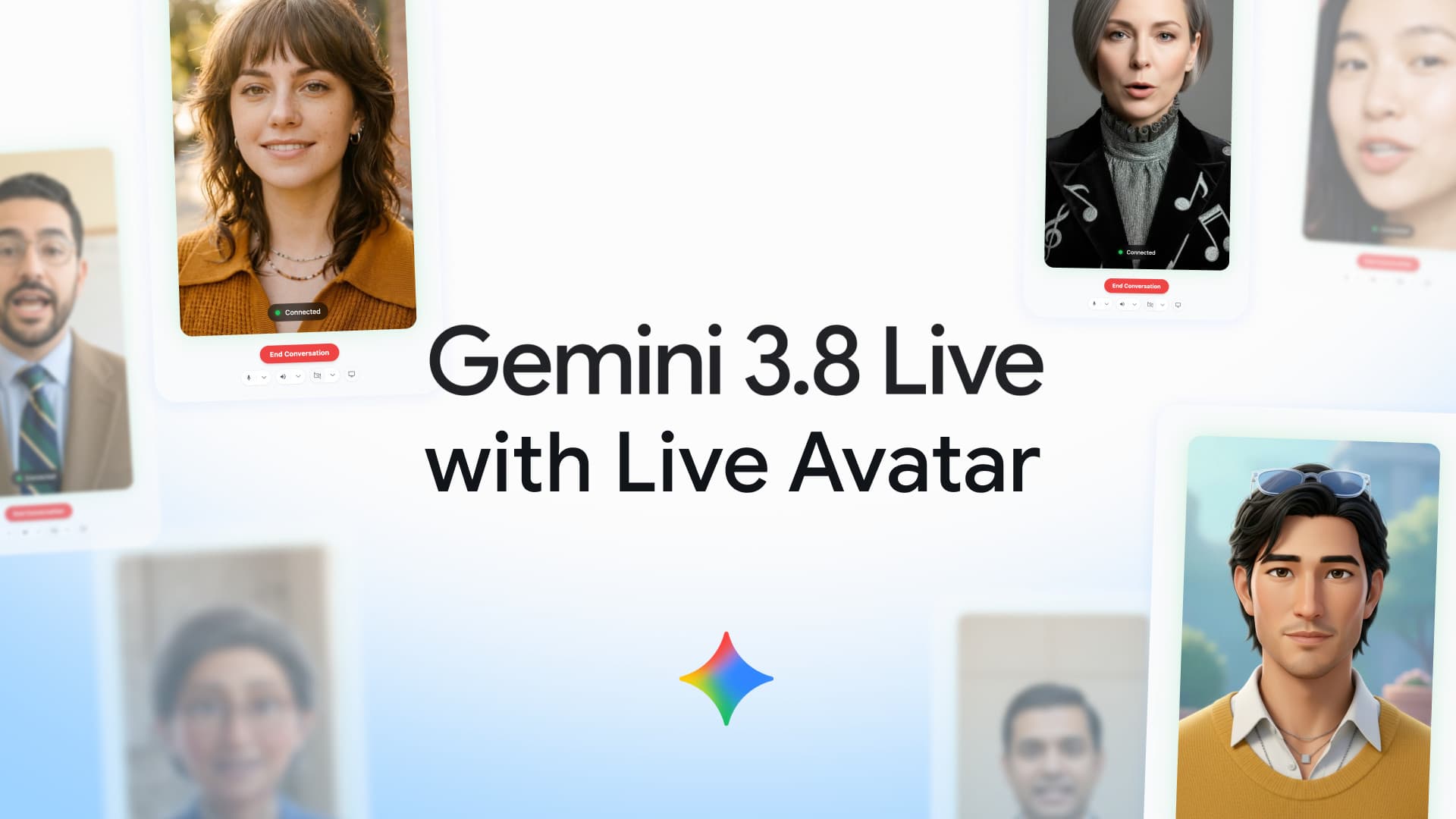
Google has moved Gemini 3.8 Live with Live Avatar out of preview and into general availability, giving enterprises a way to put a talking, lip-synced video persona in front of customers. Google DeepMind announced the release on September 24, and Google Cloud followed with the enterprise rollout details on September 25. The avatar speaks 97 languages, watermarks everything it produces, and bills its video output at $1 (around ₱62) per million tokens. For the Philippine BPO industry, which already handles a large share of the world's voice support, this is the first production-grade AI video agent from a major cloud vendor.
What Live Avatar actually does
Gemini 3.8 Live is Google's native speech-to-speech model: it listens and talks directly, without a separate speech-to-text and text-to-speech chain. Live Avatar adds near-real-time video generation on top, so the same conversation now has a face. According to Google Cloud, the GA release includes:
- Video avatars with lip-sync and natural expressions. Businesses pick from a curated library of pre-built avatars. Custom avatars generated from a reference image are limited to an allowlist and require enterprise verification.
- Fluid dialogue. The model recovers naturally when a user interrupts, and it detects speech turns without losing video alignment.
- Asynchronous tool calling. The avatar can call APIs in the background, for example to check a policy or fetch an account record, while the conversation keeps going.
- 97 languages with automatic detection. The avatar switches languages mid-conversation and keeps the lip-sync in step.
- Live visual understanding. It processes a live camera feed and screen share alongside audio at the same time.
- SynthID watermarks on every audio and video stream, so AI-generated output remains detectable.
Google's insurance demo shows the intended use: a customer describes damage and shows it on camera while the avatar fills in a claims notebook and a team of background agents checks the policy and assembles an adjuster packet. A companion Google Cloud Tech video walks through the feature set.
Watch
Gemini 3.8 Live pricing, in pesos
Google publishes the rates on its Agent Platform pricing page. All figures are per one million tokens; peso figures use a rate of about ₱62 to the US dollar.
| Gemini 3.8 Live API | Price per 1M tokens |
|---|
| Input: text | $0.75 (around ₱47) |
| Input: video, image | $1.00 (around ₱62) |
| Input: audio | $3.00 (around ₱186) |
| Output: text (response and reasoning) | $4.50 (around ₱280) |
| Output: audio | $12.00 (around ₱744) |
| Output: video (avatar) | $1.00 (around ₱62) |
The avatar's video layer is therefore cheaper per token than the audio it speaks. The real cost of a video agent is still driven by audio output at $12 (around ₱744) per million tokens, which is the same rate the plain voice model carries.
Availability: Gemini Enterprise, US and EU endpoints
Live Avatar is generally available in Gemini Enterprise and through the Gemini Live API, with provisioned throughput and enterprise compliance controls. Google Cloud lists US and EU endpoints only for now. A related model, Gemini 3.8 Live Extended Thinking, stays in private preview.
Google named several early customers. Cox Automotive built an Autotrader shopping assistant that highlights items on screen and calls tools during the chat. Equal AI, which runs more than one million live calls a day across nine Indian languages, said the new model improved interruption handling, multilingual conversations and tool-call reliability. Salesforce is integrating the model into Agentforce.
Where Gemini 3.8 Live came from
The underlying voice model is only ten days old. Google introduced Gemini 3.8 Live and 3.8 Live Extended Thinking on September 15, citing a top score of 82.6 on Artificial Analysis' Speech to Speech Quality Index for the Extended Thinking variant, 68.6% on the τ-Voice task benchmark and 97.7% on Big Bench Audio. Those models reached developers through the Gemini API and consumers through Search Live and Gemini Live in Workspace; Live Avatar is the enterprise-only layer on top.
One detail worth flagging: Google's launch posts say 97 languages, while the Live API capabilities documentation lists 99, and that list includes both Filipino (fil) and Cebuano (ceb). Google has not explained the two-language gap, so treat 97 as the official avatar figure and the documented list as the broader voice model's coverage.
What it means for Philippine call centers
Filipino is on the supported-language list, which matters because the Philippines is Google's most customer-service-heavy Gemini market in the region. Google's first Gemini Report, covered by Gizguide in July, found Filipinos submit customer-support and marketing prompts at three times the Southeast Asian average, driven by the BPO sector. A production video agent that speaks English, Filipino and Cebuano is aimed squarely at the work that industry does, and it follows AI already handling 46% of Philippine customer-service chats and Microsoft pricing AI transcription at $0.10 (around ₱6) an hour.
Two honest caveats. Google has made no Philippine-specific announcement, and Gemini Enterprise carries no local pricing: the rates above are global US-dollar rates converted at today's exchange rate. And because the service runs on US and EU endpoints only, a Philippine company deploying it would be processing customer conversations outside the country, a point its data-privacy officer will need to weigh. The same Gemini family already powers DICT's eGovAI assistant inside the eGovPH app, so the model is not new to Filipino users; a face on it is.