Key Takeaways
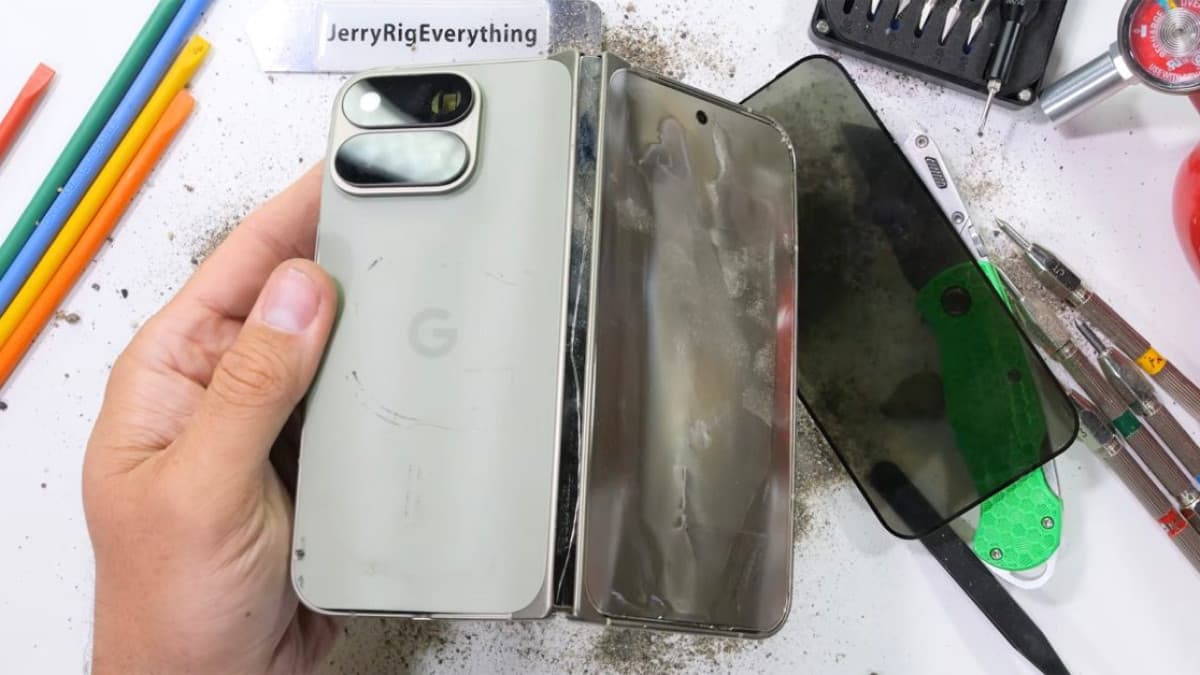
- The Google Pixel 11 Pro Fold cracked along both antenna lines next to the hinge in JerryRigEverything's bend test — the fourth straight Google foldable to break at the same spot.
- A new failure appeared this year: the front glass panel popped off entirely during the stress test.
- There was real progress too — the battery did not rupture, unlike last year's Pixel 10 Pro Fold, and the ceramic-coated outer screen resisted scratches up to level 7 on the Mohs hardness scale.
- Despite an IP68 rating, sand and grit could be heard entering the hinge.
Zack Nelson of the YouTube channel JerryRigEverything has put the Pixel 11 Pro Fold through his standard routine — scratching the screens with hardness picks, holding a flame to the inner display, pouring sand over the hinge, and finally bending the phone against its fold. The result will feel familiar to anyone who has followed Google's foldables: the phone cracked along its antenna lines when bent, exactly where the previous three generations failed.
What failed in the bend test
The weak points are the antenna lines — thin plastic breaks in the metal frame that let radio signals through. On the Pixel 11 Pro Fold they sit right beside the hinge, the exact spot where the frame needs the most structural support. When Nelson bent the phone against its fold, it cracked along both lines, and this year the front cover glass detached from the frame entirely, a failure not seen on earlier models.
As 9to5Google's coverage notes, this is the fourth year in a row a Google foldable has broken at the same point — hence the test's blunt conclusion that Google keeps repeating the same design mistake.
What actually improved
The test was not all bad news. Last year's Pixel 10 Pro Fold burst into smoke when its battery ruptured during the same test. This year, the battery survived intact. The outer display's ceramic-hardened cover also proved unusually scratch-resistant, showing no meaningful marks at level 6 of the Mohs hardness scale and only faint damage at level 7 — most glass phone screens scratch at level 6. Notebookcheck points out that Google markets this generation as three times more durable than its predecessor, which makes the repeat antenna-line failure stand out even more. The improvements are real — they are just not in the one place the phone keeps breaking.
The dust test was a mixed result. The hinge kept working after sand and grit were poured over it, without jamming outright, but fine particles could be heard grinding inside the mechanism — not what you want from a phone rated IP68 for dust and water resistance, a certification that is supposed to mean the device is fully sealed against dust.
Watch
Does this matter for buyers in the Philippines?
Google does not officially sell Pixel phones in the Philippines, so the Pixel 11 Pro Fold, which launched at $1,899 (around ₱117,000), reaches local buyers mainly through importers and gray-market sellers — usually without official local warranty service. That raises the stakes of a structural weakness: a cracked frame or detached cover glass on an imported unit means shipping it abroad for repair or paying out of pocket. A bend test is deliberately abusive and no phone in a pocket faces those exact forces, but foldables live and die by their hinges and frames, and this is the fourth year the same weak point has shown up. For a device at this price with limited local support, that track record is worth weighing before you import one.