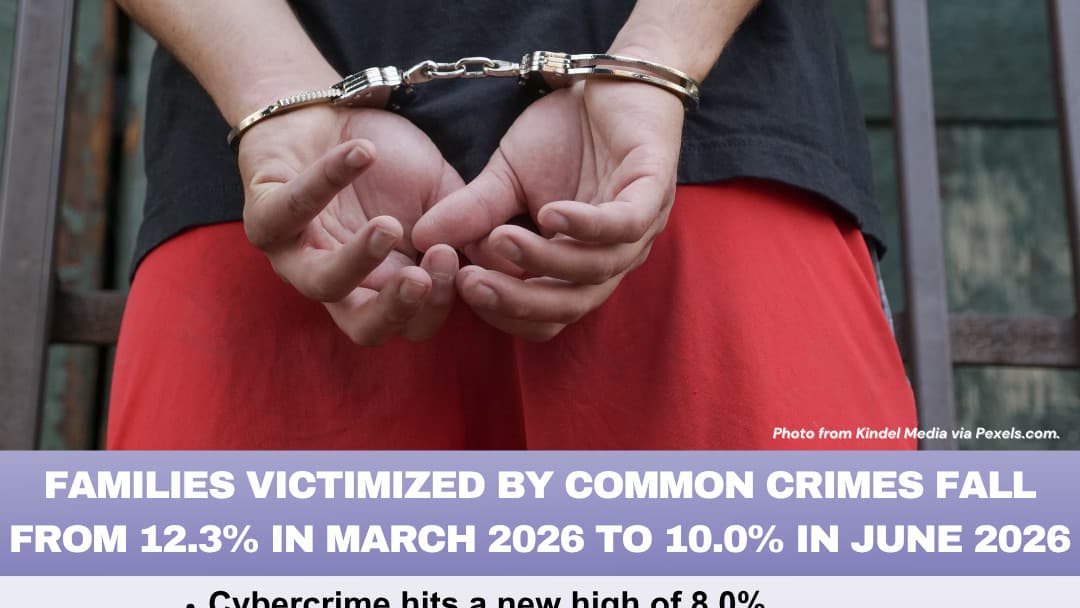
Eight percent of Filipino families had a member fall victim to cybercrime in the six months to June 2026 — the highest figure Social Weather Stations (SWS) has ever recorded — even as victimization by street-level crimes dropped to its lowest level in years. The numbers come from the SWS Second Quarter 2026 Social Weather Survey, released September 14, and they have already pushed a lawmaker to call for simpler ways for victims to report online scams.
The numbers: online crime up, street crime down
SWS interviewed 1,200 adults nationwide from June 20 to 29 — 300 each in Metro Manila, Balance Luzon, the Visayas, and Mindanao, with a margin of error of ±3% for national figures. The survey counts a family as victimized by cybercrime if a member experienced an online scam, account hacking, or cyberbullying in the past six months.
Cybercrime victimization rose to 8.0% from 5.8% in March 2026. That is the highest reading since SWS began tracking the question in June 2023. Every other crime category moved the opposite way:
- Common crimes overall: 10.0%, down from 12.3% — Daily Tribune reports this is the lowest since September 2010
- Property crimes: 9.1%, down from 11.5%
- Street robbery: 7.3%, down from 8.9%
- Break-ins: 3.5%, down from 4.6%
- Carnapping: 0.3%, down from 1.1%
- Physical violence: 1.4%, down from 1.7%
In short: crime in the Philippines is not disappearing. It is moving from the street to the screen.
Where cybercrime is rising fastest
The regional picture shows the problem is no longer concentrated in the capital:
| Area | March 2026 | June 2026 |
|---|
| Metro Manila | 10.1% | 13.4% |
| Visayas | 4.1% | 10.4% |
| Mindanao | 5.3% | 8.8% |
| Balance Luzon | 5.5% | 5.1% |
The Visayas figure more than doubled in a single quarter — the sharpest jump anywhere in the country. Balance Luzon was the only area where victimization eased.
A lawmaker wants reporting made easier
Manila 2nd District Representative Rolando Valeriano pointed to the wide gap between the survey figure and official police statistics as evidence that most cybercrime never gets reported. "We need to make it easier for victims to report cybercrimes," he said, urging closer coordination between law enforcement and online platforms, and stronger security measures and consumer protections through the DICT (Department of Information and Communications Technology), the Department of Justice, the Philippine National Police (PNP), and the Bangko Sentral ng Pilipinas. He also said victims should not be put at a disadvantage when they report a crime or seek help from institutions.
The police have responded too. PNP chief General Jose Melencio C. Nartatez Jr. ordered an intensified campaign against cybercrime on September 15, directing the Anti-Cybercrime Group and regional police units to focus on online scams, account hacking, and cyber fraud, coordinate more closely with partner agencies, and act faster on complaints.
What this means for your accounts
The survey lands in a year when the government itself has admitted its main anti-scam tool is not working: the PNP has said the SIM Registration Act has failed to stop scams and is pushing for biometric registration instead, while enforcement actions like the NBI's raid on a Parañaque online scam hub continue. Until reporting gets simpler, the practical burden stays on users: treat one-time passwords (OTPs — the codes apps text you to confirm a login) as secrets, be skeptical of links sent over chat, and report incidents to the PNP Anti-Cybercrime Group even when the amount lost seems small — the survey suggests the official numbers badly undercount what Filipino families are actually experiencing.