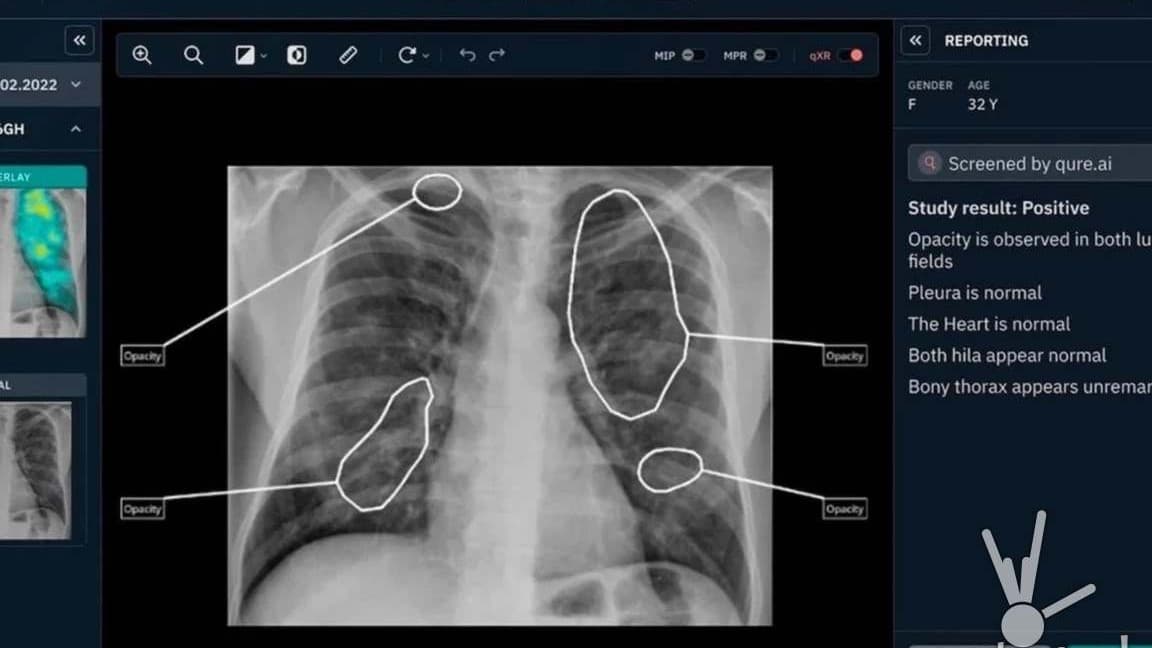
Artificial intelligence could make tuberculosis (TB) screening meaningfully cheaper in the Philippine towns that need it most. A study by Ateneo de Manila University researchers, published in the August 2026 issue of the journal BMC Health Services Research, projects that using AI to read chest X-rays in rural health units would cost about ₱877 per patient, against roughly ₱1,142 per patient for standard manual reading — a saving of about 23 percent, according to the study's release on EurekAlert.
The research was conducted by Harold Henrison Chiu, Bryan Christopher Lao and Gloanne C. Adolor, and it tackles a specific bottleneck in Philippine public health: rural health units often have X-ray machines but no radiologist nearby, so images wait for a specialist or a teleradiology service — and patients wait with them.
What the researchers modeled
The team built a decision-analytic model — a structured cost simulation rather than a field trial — around a theoretical cohort of 1,000 presumptive TB patients per year undergoing chest radiography in rural health units, tracked over five years. The model priced in AI software and operating expenses, radiologist reading fees, and confirmatory GeneXpert molecular testing, which remains required because an AI flag alone cannot confirm TB.
The headline numbers:
| Screening approach | Annual cost (1,000 patients) | Cost per patient |
|---|
| AI-assisted X-ray reading | ~₱877,330 | ~₱877 |
| Manual / teleradiology reading | ~₱1.14 million | ~₱1,142 |
The caveats the authors themselves flag
The savings are not guaranteed everywhere. In sensitivity analyses, the economic advantage shifted under different assumptions: when lower manual reading fees were used, or when diagnostic performance estimates drawn from Philippine settings were applied, AI-assisted screening remained effective but was no longer clearly cheaper, News-Medical reported. In other words, whether AI saves money depends heavily on local prices — what a health unit currently pays for reads, and what the AI vendor charges.
That is why the authors recommend targeted pilots in underserved rural health units — with local validation, quality assurance monitoring and budget assessment — rather than an immediate nationwide rollout. As the researchers put it: "For resource-constrained communities, the most important question is therefore not whether AI can outperform or assist an expert reader, but whether it can extend expert-level support to places where expertise is scarce in a way that is affordable, sustainable, and equitable."
Why this matters for TB control in the Philippines
The Philippines carries one of the world's heaviest TB burdens. An estimated 739,000 Filipinos developed TB in 2024 — about 6.8 percent of the roughly 10.8 million cases worldwide, per World Health Organization figures cited in the study coverage, including ASTIG.ph. Early detection is what stops severe disease and community transmission, and the scarcity of radiologists outside major cities is a direct brake on it.
A peso-denominated cost model matters here because it turns "AI in healthcare" from a slogan into a budgeting question a rural health unit or the Department of Health can actually evaluate: ₱877 versus ₱1,142 per patient, under stated assumptions. It joins a growing list of public-sector AI deployments in the country, such as Project NOAH's ₱1-billion AI flood forecasting program. The study's own discipline is worth keeping, though: the numbers are projections from a model, the savings hinge on local pricing, and the sensible next step is pilots that test whether the arithmetic holds in a real Philippine health unit.