Filing a Meralco net metering application costs nothing, but a household should budget ₱1,500 for the Energy Regulatory Commission (ERC) fee and up to ₱3,000 if its old meter must be replaced, according to Meralco's Apply for Net Metering guide. Once the system is approved, every kilowatt-hour (kWh) your solar panels send to the grid earns a peso credit on your bill.
This guide explains how to apply for Meralco net metering: who qualifies, what it costs, the documents on Meralco's June 2026 checklist, and the six stages from the first form to your first bill credit.
What Meralco net metering is
Net metering lets you run a renewable-energy system, usually rooftop solar, connected to the Meralco grid. Your home uses its own solar power first. When the panels make more than you need, the extra power flows to the grid through a bi-directional meter (a meter that counts power going both ways), and it earns a peso credit, Meralco's Solar and Net Metering page explains.
Two points matter for your budget:
- Exports are not credited at the full retail rate. The credit uses a monthly export rate based on Meralco's blended generation cost, so it changes from month to month.
- The cap is 100 kW per customer. Meralco can approve less, depending on your system and the local network.
Solar PV is the most common system, but Meralco says wind, hydro, biomass and other allowed technologies can also qualify.
Who can apply
Meralco lists four conditions on its net metering page:
- You are a new or existing Meralco customer (residential, business, industrial or government).
- Your account is in good standing, with no unpaid Meralco obligation when you apply.
- The electric service is registered in your name, or you have the required authorization.
- Your equipment, capacity, protection, service entrance, permits and connection pass Meralco's review.
If your account is not in your name yet, sort that out first. You can check the account name on your bill, or online through My Meralco.
How much does Meralco net metering cost?
Meralco's FAQ says there is no fee to submit the application, and the Distribution Impact Study, testing and commissioning are not charged to you. An ERC advisory dated 22 September 2025 adds that testing and commissioning are the utility's job "at no cost to the applicant". These are the costs that can apply:
| Item | Amount | When it applies |
|---|---|---|
| Application filing | Free | Always |
| Distribution Impact Study, testing and commissioning | Free | Always |
| ERC Certificate of Compliance (COC) fee | ₱1,500 | Always |
| Difference in Meter Cost (DIMC) | Up to ₱3,000 for homes | Only if you still have an old one-way meter |
| LGU electrical permit and Certificate of Final Electrical Inspection | Set by your city or town | Always |
| Distribution Asset Study or network work | Case by case | Only if your local network needs an upgrade |
| Solar panels, inverter and installer | Your installer's quote | Always |
The ₱1,500 COC fee and the ₱3,000 meter-cost cap come from Meralco's documentary requirements checklist. The checklist says to pay the COC fee through the ERC-LBP Link.BizPortal once ERC sends its Statement of Account, then give Meralco the proof of payment. Cash, cashier's check or manager's check payable to "Energy Regulatory Commission" can also be handed to Meralco, which passes it to ERC.
How much is an exported kWh worth?
This is the number that decides how big a system makes sense. Using Meralco's own October 2026 tables:
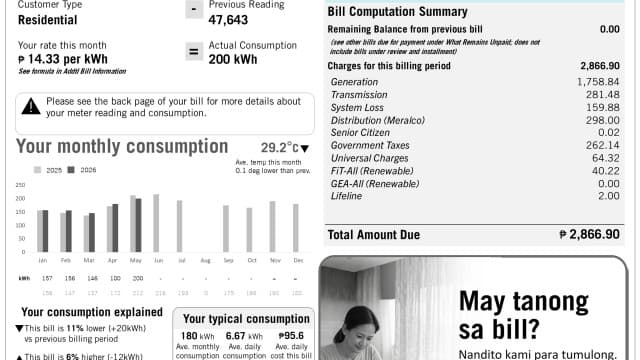
- Power you use at home. Meralco's October 2026 typical-bill table puts a 300 kWh home at ₱4,611.23 and a 200 kWh home at ₱3,012.30. By our math, if solar covers 100 kWh of that household's use, the bill drops by ₱1,598.93, about ₱16 per kWh.
- Power you export. Meralco's October 2026 generation-charge breakdown lists energy exported by net metering customers at an average of ₱9.6372 per kWh. At that value, 100 kWh exported is worth about ₱964 in credits.
So in October 2026, a kWh you used yourself was worth roughly 1.7 times a kWh you exported (₱1,598.93 ÷ ₱963.72). The assumption: a 300 kWh home and October's figures, which change every month. This is why Meralco tells applicants to size the system around the appliances that run in daytime, instead of building mainly to export.
The economics have improved. In a May 2026 analysis, the energy think tank Ember estimated that the payback time for home rooftop solar in the Philippines fell from 4.0 years to 3.1 years in twelve months, as retail power prices rose.
Paano mag apply ng net metering sa Meralco?
In short: download Meralco's current application form and checklist, fill them in with your installer's equipment details, and submit them to Meralco. Meralco then studies your connection and inspects your service entrance. You get your city's electrical permit and inspection certificate, sign the net metering agreement, pay the fees, and Meralco installs or sets up the meter and tests the system. The six stages below explain each step.
The six stages, step by step
Meralco's application guide splits the process into six stages:
- Application. Complete the current form and submit it with your account, applicant, project, equipment, installer and authorization details.
- Evaluation. Meralco runs a Distribution Impact Study. It checks whether the local network can safely take your system: transformer loading, voltage, power quality, protection and hosting capacity. If upgrades are needed, Meralco may also require a Distribution Asset Study.
- Inspection. Meralco inspects your service entrance. You complete any corrections it asks for and secure the LGU electrical permit and the Certificate of Final Electrical Inspection (CFEI).
- Completion. Submit the remaining documents, sign the Net Metering Agreement and the Fixed-Asset Boundary Document, and pay the fees that apply.
- Energization and commissioning. Meralco installs or configures the approved meters and tests the system before it may run in parallel with the grid.
- Transmittal. Meralco sends the completed documents and your payment record to ERC for the Certificate of Compliance. The ERC advisory confirms that the utility files the COC on your behalf.
During testing, Meralco checks the anti-islanding protection: the system must stop feeding the grid within 2 seconds during a brownout, and reconnect only 10 minutes after Meralco's supply returns. This protects linemen working on the lines.
Documents to prepare
Meralco's application form and checklist ask for:
- Customer details: full name, Customer Account Number (CAN), Service ID Number, the service address where the panels are installed, phone and email.
- Project details: installer name, start and completion dates, and type of installation (rooftop, ground-mounted or floating).
- Equipment details: panel brand, model, rating and number of panels; inverter brand, model, maximum AC output and phases; and battery details with the transfer switch type, if you have one. An Annex sheet is used for several panel, inverter or battery models.
- A representative's papers, if someone applies for you: an authorization letter or Special Power of Attorney for a residential account, plus one valid ID of the representative.
- After inspection: the CFEI from your LGU and the signed Net Metering Agreement. The ERC advisory says notarization of the agreement is not mandatory and electronic signatures are allowed.
- REC meter choice: the form asks whether you want a Renewable Energy Certificate (REC) meter, which measures your panels' total output. It is optional. If you decline it, the checklist requires a notarized affidavit and waiver, and Meralco estimates your generation with a set formula.
The ERC advisory also bars utilities from asking for extras such as a bill of materials or solar equipment catalogs.
Check your transformer's hosting capacity
Your street transformer limits how much solar it can take. Meralco publishes this indicative table of the total solar capacity for common single-phase transformers. Its final assessment can approve less.
| Transformer size | Indicative hosting capacity |
|---|---|
| 10 kVA | 7 kW |
| 15 kVA | 7 kW |
| 25 kVA | 10 kW |
| 37.5 kVA | 14 kW |
| 50 kVA | 19 kW |
| 75 kVA | 29 kW |
| 100 kVA | 38 kW |
Meralco labels each figure an aggregate maximum, meaning it covers all the solar connected to that transformer, not just yours.
How long does approval take?
Meralco does not promise one fixed date. Its FAQ says timing depends on permits, study results, corrections, inspection, payments and commissioning. The government has set these targets:
- Utility processing: the ERC advisory puts testing and commissioning within the utility's 20-day processing time under ERC Resolution No. 15, Series of 2025. A Department of Energy advisory dated 30 March 2026 then ordered utilities to finish net metering applications within 10 working days during the state of national energy emergency, "until otherwise advised".
- LGU permits: under a joint circular of the DILG, DOE and DPWH, the electrical permit must be processed within 3 working days and the CFEI within 7, the DILG said. The DOE's emergency advisory shortened the CFEI to 3 working days and treats a permit as approved if the LGU does not act in time.
- If your CFEI is late: Meralco's checklist accepts the LGU's Acknowledgment Receipt and Official Receipt in place of a CFEI that is deemed approved, so testing can proceed. You still submit the actual CFEI once issued.
Ask Meralco which timeline applies to your application when you file.
When your bill credits start
Credits begin after the meters are installed, the system passes commissioning, and a special meter reading marks the start of net metering service, Meralco says. The ERC advisory encourages utilities to apply export credits from the date of successful testing and commissioning, on the first bill issued after it, regardless of when the COC application reaches ERC. This is encouraged rather than mandated, so confirm the start date with Meralco.
Unused credits are banked and carried over to later bills. They are bill credits, not cash. They do not follow you to a new address; contact Meralco before you sell the property, close the account or move.
If you don't want to export at all
Do not switch on a grid-connected system before approval. Meralco warns that an ordinary one-way meter may record exported power as extra consumption, and an unapproved connection is a safety risk. If you only want to use your own solar power and never export, Meralco points to its zero-export and micro solar options instead. The DOE has also removed permits and fees for small zero-export home solar setups.
Where to submit and ask questions
Meralco's guide says to submit through the Meralco channel that serves your account, but it does not name a single address. Before you file, ask Meralco which channel to use through the contacts on its Help and Support page: the (02) 16211 hotline, customercare@meralco.com.ph, or any Meralco Business Center. Meralco also asks applicants to download a fresh copy of the form and checklist each time they submit.