Meta will open its first office in the Philippines, giving the government a direct line for getting violent and illegal posts removed faster, National Bureau of Investigation (NBI) Director Melvin Matibag said in remarks reported by Philstar.com on August 30. The commitment came out of last week's meeting between Philippine officials and regional executives of Meta — the company behind Facebook, Instagram, and Messenger — at its Asia-Pacific headquarters in Singapore.
Officials have complained for years that Meta keeps no full office in the country, even though Facebook is the most heavily used social platform in the Philippines. They say the distance slows down law-enforcement requests and content takedowns — a delay that turned deadly serious this year.
Why Meta agreed to open a Philippine office
The office is meant to close that gap. Matibag said a local presence will let authorities talk to Meta directly so that posts flagged by the government can be taken down immediately, according to GizGuide's report on the announcement. No opening date, location, or staffing plan has been announced yet — for now, this is a commitment, not a ribbon-cutting.
The stakes were set by two school shootings: one in Tacloban City in June, and another at Ateneo de Zamboanga University on August 18. In the Zamboanga attack, the shooter livestreamed on Facebook. Government monitors flagged the feed within five minutes, but the video stayed live for about nine more minutes before it came down, BitPinas reported. Those nine minutes became the government's case that email threads with a Singapore office are not fast enough.
Data sharing against 'nihilistic violent extremism'
Beyond the office, Meta committed to share data with Philippine authorities to fight what officials call nihilistic violent extremism, or NVE — a label for violence that is glorified, encouraged, or spread online without a clear political or religious cause. Authorities see NVE as a factor in both school shootings.
"Meta would respond to what we're requesting to address the problem of NVE, so they would provide information and share data," Matibag said.
From ban threat to working group to office
The office commitment is the latest step in a standoff that escalated quickly in August. The Cybercrime Investigation and Coordinating Center (CICC) first said it was studying a possible Facebook ban over slow takedowns, telcos blocked more than 100 sites streaming violent content, and the Palace said the President was open to banning platforms that harm the youth.
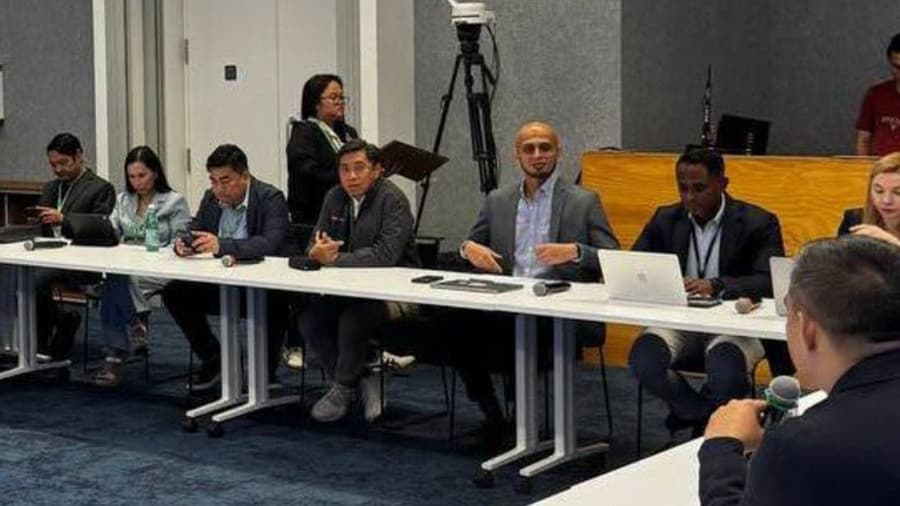
The pressure eased on August 27, when the Facebook ban was ruled out after a Philippine delegation — led by Department of Information and Communications Technology (DICT) Secretary Henry Aguda, with the NBI, the National Telecommunications Commission, the CICC, and lawmakers — met Meta in Singapore. The two sides agreed on a technical working group, a direct hotline, and a dedicated Meta point of contact for Philippine authorities. A physical office goes one step further than all of those: it puts people accountable to those commitments inside the country.
National ID checks without handing Meta your data
The government also wants to connect Meta's user verification with the Philippine Identification System (PhilSys) to curb fake and anonymous accounts. Under the plan, Meta would query an API — a controlled software connection — and the Philippine Statistics Authority would answer only whether an ID number matches its records. The personal data itself stays with the government.
"We are not giving Meta access to the information contained in our database. The purpose is simply to verify," CICC Executive Director Renato "Aboy" Paraiso said.
That design matters in a country still dealing with the fallout of large-scale data leaks. Verification by yes-or-no answer is a far narrower arrangement than handing a foreign platform a copy of the national ID database, though privacy advocates will likely want to see the technical details before the system goes live.
What Filipino users should watch next
For everyday users of Facebook and Instagram in the Philippines, three things will show whether this deal has teeth. First, whether the office opens with trust-and-safety staff who can actually order takedowns, or serves only as a liaison desk — the nine-minute Zamboanga delay is the benchmark to beat. Second, whether the PhilSys verification link launches with the privacy limits officials are promising. And third, where the government's platform-by-platform child-safety campaign goes next: Aguda has said Discord is on the list, following earlier scrutiny of grooming risks on Roblox.