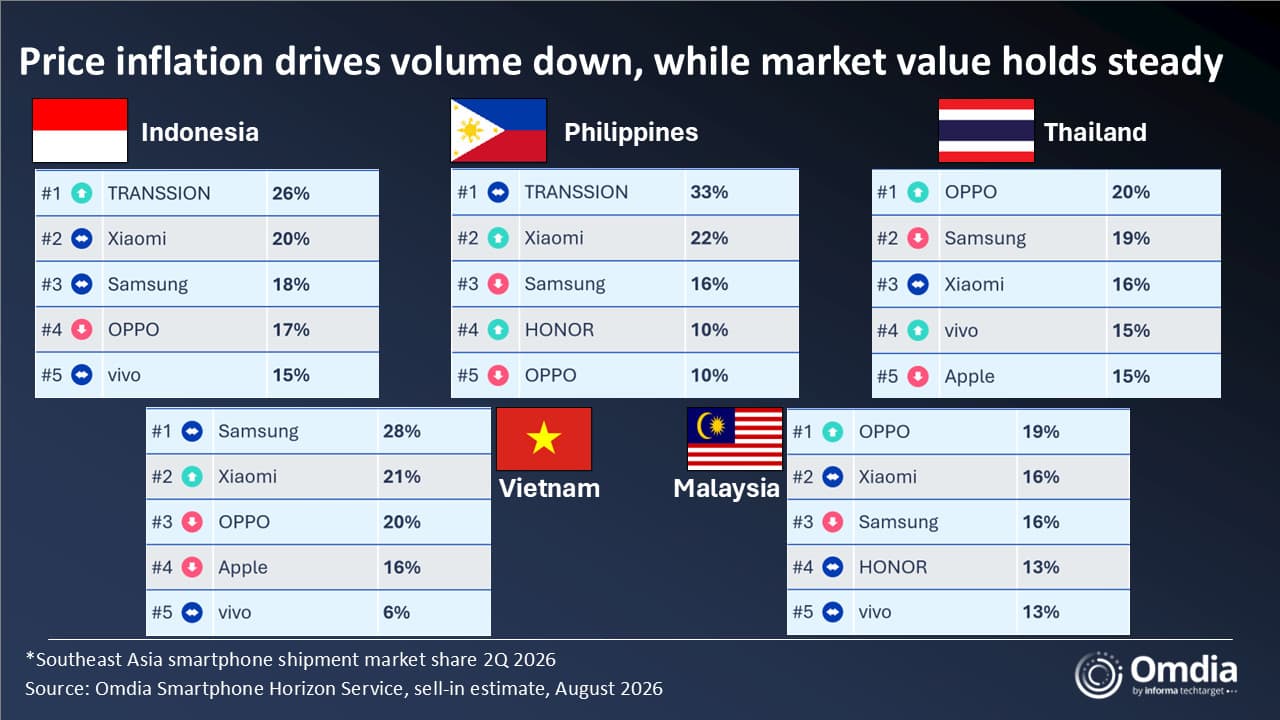
The short version: TECNO, Infinix, and itel — the three brands owned by Transsion — shipped a third of all smartphones sold in the Philippines in the second quarter of 2026, HONOR broke into the local top five for the first time, and the cheapest phones are disappearing from the market. That is the picture from research firm Omdia's Q2 2026 shipment data, reported on August 27-28 by TelecomLead and GadgetPilipinas.
Philippine smartphone market share, Q2 2026
| Rank | Brand | Share of shipments |
|---|
| 1 | Transsion (TECNO, Infinix, itel) | 33% |
| 2 | Xiaomi | 22% |
| 3 | Samsung | 16% |
| 4 (tie) | HONOR | 10% |
| 4 (tie) | OPPO | 10% |
Together, the top five brands took 91% of shipments, leaving just 9% for Apple, vivo, and everyone else.
The budget kings are moving upmarket
Transsion built its Philippine lead on phones under $100 (around ₱6,200). That base is shrinking fast: Omdia's data shows the group's sub-$100 shipments fell 47%, while its $100-199 (around ₱6,200 to ₱12,300) shipments grew 12% — making that its largest price band, carried by models like the Infinix HOT 70 and TECNO SPARK 50 4G.
Xiaomi, in second place, shows the same shift more sharply. Its sub-$100 shipments dropped 69% while its $100-199 devices jumped 55%, and its average selling price surged 43.5%. OPPO had the roughest quarter of the top five: its sub-$100 shipments collapsed 96%, the steepest decline among the leaders.
vivo, which missed the top five, tells the same story from outside it: per GadgetPilipinas' report of the Omdia data, it cut the sub-$100 share of its shipments from 32% to just 5%. Across every brand, the cheapest tier is being abandoned, not just shrinking on its own.
Samsung held third place despite price increases on entry models like the Galaxy A07 and A17, and gained ground in the $200-299 (around ₱12,400 to ₱18,500) segment. Regionally, its shipments fell only 11% — far gentler than the 21-41% declines of its rivals. Its strategy of stretching value further up the ladder is visible locally in releases like the Galaxy S26 FE at ₱46,990.
HONOR's 10% share is its first appearance in the Philippine top five. Omdia's figures make it the fastest-growing major smartphone brand in both the Philippines and Malaysia this quarter, growing 15% regionally even as the overall market contracted.
Southeast Asia is shrinking while prices climb
The backdrop is a regional slump. Southeast Asian smartphone shipments fell 23% year-on-year to 19.3 million units in the quarter — down 5.7 million units from the 25 million shipped in Q2 2025, and the lowest quarterly level since 2014. Yet the market's value still reached $6.6 billion (around ₱410 billion), because average selling prices rose 31% to $342 (around ₱21,200). The $100-199 band expanded from 32% to 39% of all regional shipments, roughly 7.5 million devices.
Omdia expects more of the same: its forecast puts full-year 2026 regional shipments at 75.3 million units, down 25% from the roughly 100.4 million devices shipped in 2025, with rising memory costs adding pressure in the second half — the same component squeeze already showing up in projected iPhone 18 Pro pricing.
What this means for your next phone
If you buy phones at the entry level, the data explains what you are seeing in stores: genuinely cheap phones under ₱6,200 are getting scarce, and the market's center of gravity has moved to the ₱6,200-12,300 band. With memory costs still climbing into the holiday quarter, the practical advice from the numbers is unsentimental — the sub-₱10,000 phone you are waiting to go on sale may cost more, not less, by December. Brand-wise, competition in the mid-range is heating up, with HONOR's arrival in the top five giving buyers a fifth serious option alongside the TECNO-Xiaomi-Samsung-OPPO establishment. For sellers and buyers alike, the value equation this holiday season will be set less by discounts and more by which brands can keep mid-range prices steady while component costs rise.