Meta's Most Comprehensive Teen Safety Update Yet
On June 17, 2026, Meta announced its most expansive set of teen safety features since introducing Teen Accounts in 2024. The update spans Instagram, Facebook, and Messenger and introduces four distinct systems working in combination: a globally deployed age-appropriate content filter, AI-powered age detection for accounts that may misrepresent a user's age, a new parental alert for self-harm searches, and a consolidated Family Center for supervision across all Meta platforms.
Taken together, the changes aim to make it harder for underage users to access adult content even if they lie about their age at sign-up — and to give parents earlier, more actionable signals when their teens may be at risk.
13+ Content Settings: Movie Ratings for Social Media
The most visible new default is the global rollout of Meta's "13+ content setting," modeled on the criteria used for movie rating classifications. The setting is now on by default for all teen accounts and suppresses content in Feed, Reels, and Messenger that contains violence, sexual themes, self-harm depictions, and other material considered age-inappropriate.
The criteria were developed in consultation with child safety organizations and parents, though external advocates have noted that the definition of "inappropriate" still involves significant judgment. Meta acknowledged the system is imperfect and described it as a layer of protection rather than a complete solution.
For teens aged 13 to 15, the 13+ setting is locked — it cannot be disabled without a parent's explicit approval. Teens aged 16 and 17 retain more flexibility to adjust settings independently, though Meta's protective defaults apply unless changed. Direct messages from accounts a teen is not already connected to are blocked by default, and live-streaming requires parental permission for users under 16.
AI Age Detection: Physical Cues, Not Facial Recognition
The more novel element of the June 17 announcement is Meta's expanded use of AI to identify accounts that may be younger than the age declared at registration — and to automatically place them in Teen Account protections.
The AI system works on two categories of signals:
Contextual signals include textual and behavioral cues across the platform — birthday mentions, school grade references, and conversation patterns that suggest a younger user.
Visual characteristics introduce new territory: the system examines general physical attributes visible in photos and videos, such as height and bone structure, to infer whether an account holder is likely a minor. Meta was explicit that this is "not facial recognition" and does not identify or tag individuals — the assessment is probabilistic and applied at the account level, not to personal identification.
If discrepancies are detected between a user's declared age and observed signals, the account is flagged and may be automatically enrolled in Teen Account protections. Privacy and child safety advocates have reacted with a mix of appreciation for the protective intent and concern about the precedent of automated physical assessments by a major social platform, even in a non-identifying capacity.
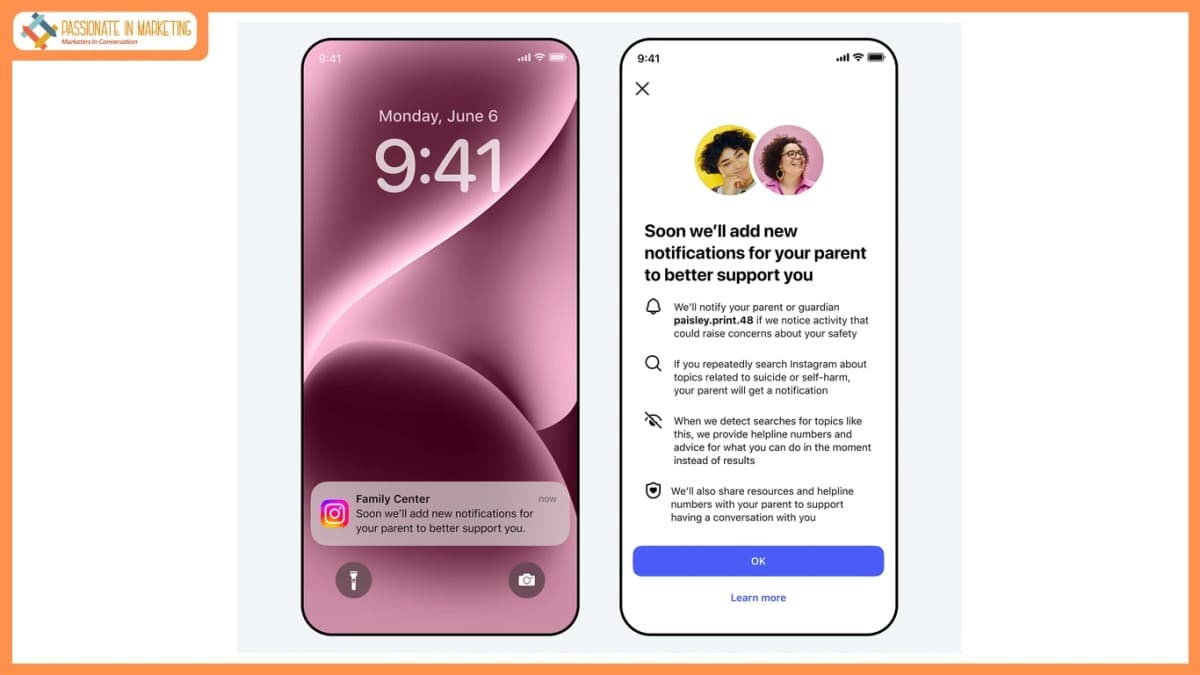
Parental Alerts for Self-Harm Searches
A third feature — targeted initially at the EU, Brazil, and India — delivers notifications to parents using Instagram's supervision tools when their teen repeatedly searches for terms related to suicide or self-harm within a short time period. The notification does not share the specific search terms, but alerts parents that their teen may need support or a conversation.
The geographic limitation reflects regulatory sensitivities around data handling in different jurisdictions. Meta did not announce a timeline for global expansion of the alert feature.
Family Center: Unified Supervision Across Meta Platforms
Meta consolidated its parental tools into a single dashboard at familycenter.meta.com/supervision. Parents who supervise their teen can now manage settings across Instagram, Meta Horizon (VR), Facebook, and Messenger from one location — previously, each platform required navigating its own separate supervision settings.
The teen account defaults active across platforms include: accounts set to private by default, direct messages blocked from strangers, time-limit reminders, and a nighttime sleep mode that prompts teens to log off at bedtime.
Regulatory and Civil Society Context
Meta's acceleration of teen safety features reflects sustained pressure from multiple directions. In the United States, Congress has debated the Kids Online Safety Act, and multiple state-level laws targeting teen social media access have passed or are pending. Australia enacted age-verification legislation in 2024. The EU's Digital Services Act places systemic risk obligations on large platforms that include protecting minors.
Government agencies and civil society groups broadly welcomed the June 2026 update but were equally clear that more remains to be done — particularly around harmful content that evades the 13+ filter, misinformation, and scams targeting minors. Meta has not committed to a specific timeline for extending the parental self-harm alert feature to all markets.
Sources: