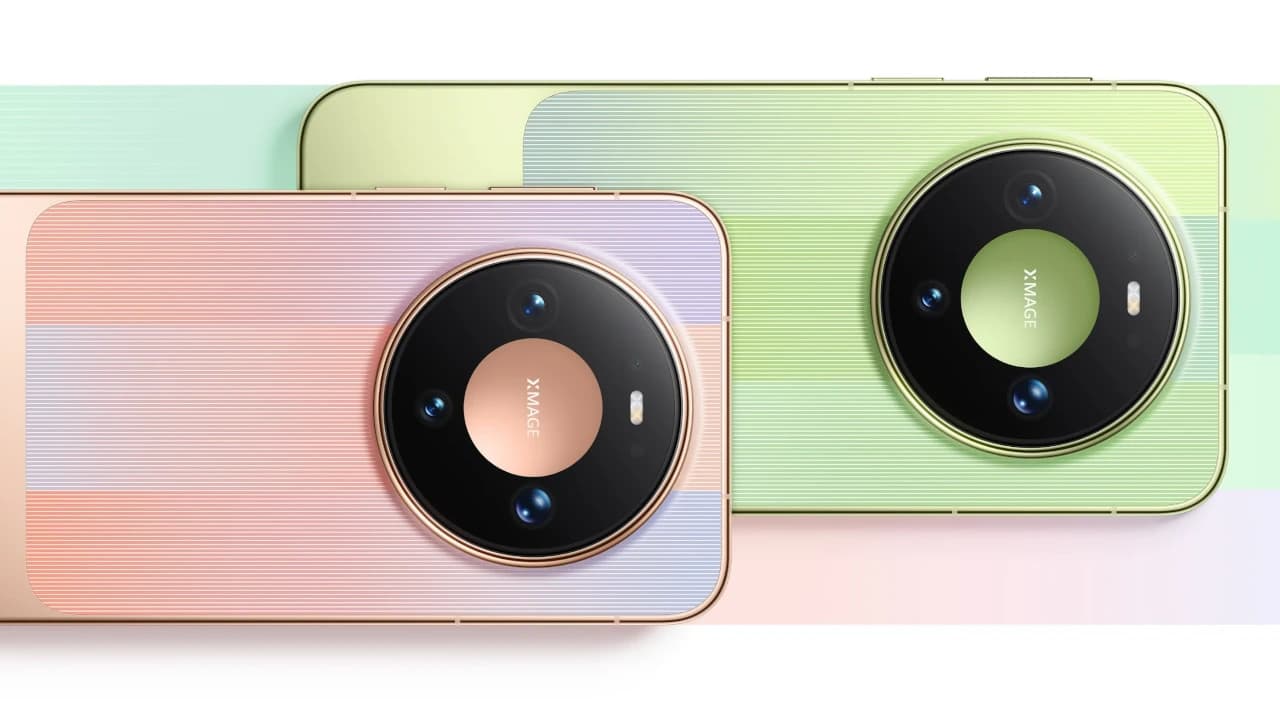
Huawei has launched the Mate 90 and Mate 90 Pro in China, pairing new in-house Kirin chipsets with 6,600mAh batteries and — on the Pro — a dual-layer OLED display that Huawei rates at a striking 12,000 nits of peak brightness. Prices start at CNY 5,999 (around ₱55,900) for the Mate 90 and CNY 6,999 (around ₱65,200) for the Mate 90 Pro, with both phones running HarmonyOS 7, Huawei's own operating system, out of the box.
GSMArena's launch coverage details the split between the two models, and it is wider than usual this generation.
Mate 90 Pro: the 12,000-nit display is the headline
Both phones use a 6.75-inch LTPO OLED panel with 1280p+ resolution and an adaptive 1-120Hz refresh rate (LTPO lets the screen drop its refresh rate to save power). The Pro's panel, however, is a dual-layer OLED — two emitting layers stacked on top of each other — which is how it reaches the claimed 12,000-nit peak, far beyond the 2,000-5,000 nits typical of current flagships. The standard Mate 90 uses a conventional single-layer panel.
The chipsets split the same way:
| Mate 90 | Mate 90 Pro |
|---|
| Chipset | Kirin 9030 | Kirin 9035 |
| Display | 6.75" LTPO OLED, 120Hz | 6.75" dual-layer LTPO OLED, 12,000 nits |
| Battery | 6,600mAh | 6,600mAh |
| Wired / wireless charging | 66W / 50W | 100W / 50W |
| Main camera | 50MP RYYB, f/1.4-f/4.0, OIS | 50MP RYYB, f/1.4-f/4.0, OIS |
| Telephoto | 50MP 4x, f/2.2, OIS | 50MP 4x, f/2.1, OIS, 5cm macro |
| Starting price | CNY 5,999 (≈ ₱55,900) | CNY 6,999 (≈ ₱65,200) |
Huawei says the Pro's Kirin 9035 delivers about a 20% performance uplift over its predecessor, with a GPU capable of hardware ray tracing, while the standard model's Kirin 9030 claims a 27% improvement over the chip in last year's base Mate. These are Huawei's own silicon designs — the company has leaned on homegrown chips since US export restrictions cut it off from foreign processors.
Battery, cameras and durability
The 6,600mAh battery in both phones is rated for up to 41 hours of continuous video playback. The main camera on both is a 50MP sensor using Huawei's RYYB color filter (which swaps green sub-pixels for yellow to capture more light) behind a variable f/1.4-f/4.0 aperture, joined by a 40MP ultra-wide. The Pro's 4x periscope telephoto adds a 5cm macro mode for close-ups. Both carry IP68 water resistance rated to 6 meters, plus IP69K against high-pressure jets.
Configurations top out at CNY 8,499 (around ₱79,200) for the Mate 90 with 1TB of storage and CNY 10,000 (around ₱93,200) for the Mate 90 Pro with 16GB of RAM and 1TB. A higher-end Pro Max variant was introduced at the same launch event, per Gadget Pilipinas' report.
Will the Mate 90 reach the Philippines?
Not yet, and no date has been promised. Huawei has only announced China availability; global pricing and rollout have yet to be announced. The precedent is encouraging, though — the Mate 80 generation reached global markets about five months after its China debut, and Huawei continues to sell phones, tablets and wearables officially in the Philippines. The peso figures above are conversions of China prices, not official Philippine prices; Huawei devices that do reach the Philippines are typically priced separately.
There is also the usual caveat for Huawei flagships sold outside China: no Google services, with Huawei's HarmonyOS ecosystem in their place. Camera-focused buyers may still care — Huawei's imaging pedigree is real, with the Pura 80 Ultra still sitting above the iPhone 18 Pro in DXOMARK's camera rankings. If the Mate 90 Pro's display and camera hardware arrive here intact, it will be one of the most interesting imports of the year.