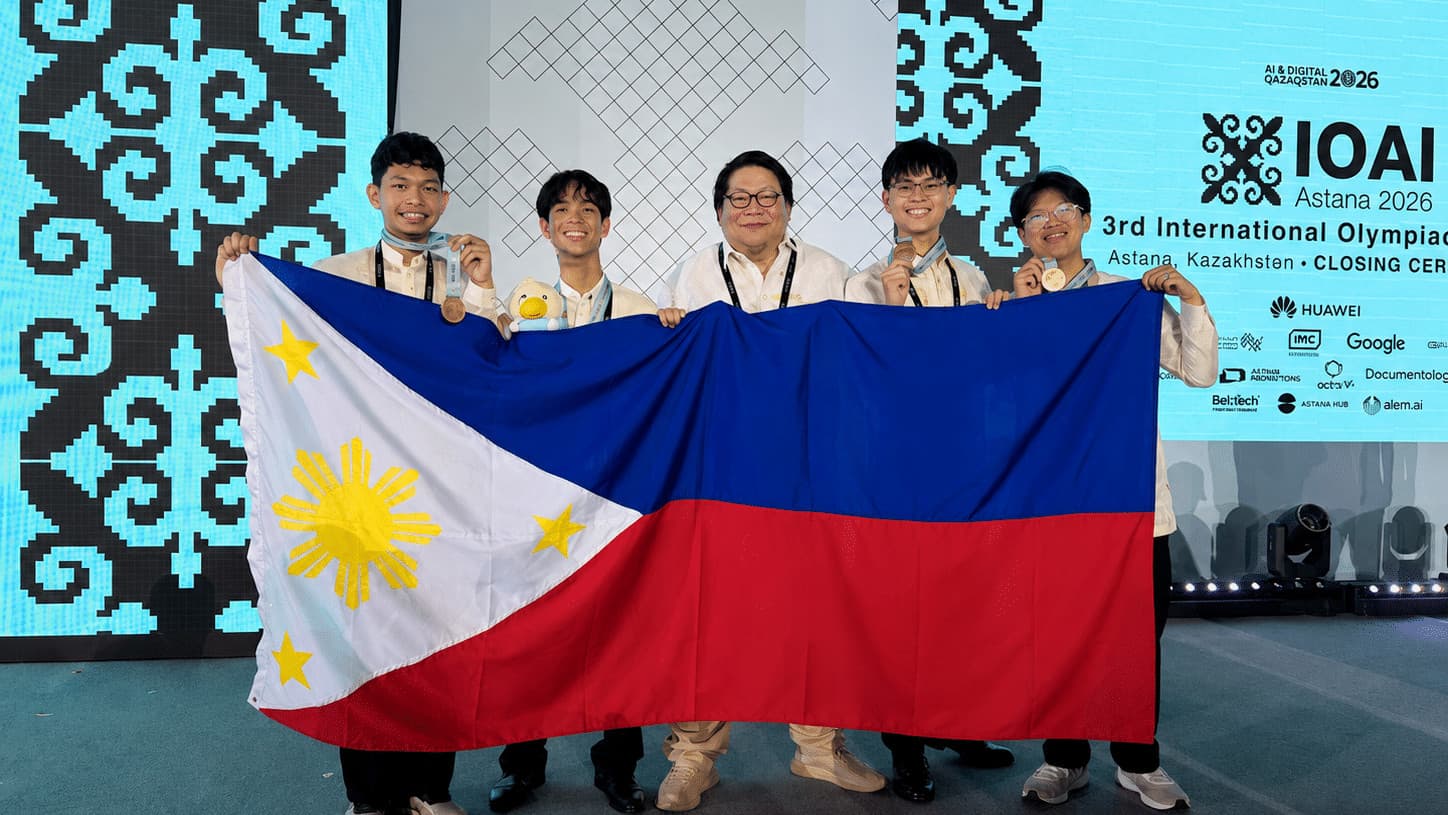
All four members of the Philippines' first-ever delegation to the International Olympiad in Artificial Intelligence (IOAI) came home with medals — one silver and three bronze — from the 2026 competition in Astana, Kazakhstan, Inquirer Technology reported. The team competed against 466 high school students from 108 countries and territories in a week-long contest covering machine learning, computer vision, natural language processing, and multimodal processing — the core skills behind modern AI systems.
A 100% medal rate on debut is rare company: the Philippines was among only 11 of the 18 countries debuting at IOAI 2026 to win at least one silver medal, Journal Online reported. Across the whole field, organizers awarded 37 gold, 73 silver, and 110 bronze medals.
The medalists
- Theo Lorenzo T. Bustamante (Philippine Science High School-CALABARZON Region Campus) — Silver, ranking 80th overall out of 466, in the top 17% of the field
- Ellison Matthew S. Ang (Philippine Science High School-Main Campus) — Bronze
- Juan Mateo J. Desuasido (Brent International School Manila) — Bronze
- Jhareign S. Solidum (University of Mindanao Ilang High School) — Bronze
The roster itself says something about where AI talent is growing in the country: two Philippine Science High School campuses, an international school in Manila, and a university-run high school in Mindanao.
Who built the team
The delegation was selected, trained, and managed by International Olympiad in Artificial Intelligence Philippines (IOAI PH), hosted by the Ateneo Business Insights Laboratory for Development (BUILD) under Ateneo de Manila University's John Gokongwei School of Management.
"A 100% medal rate on our global debut proves that Philippine talent can immediately compete at the highest level of international AI," said team leader Martin Gomez.
The effort had backing from the Office of the President, the Department of Education, and the Department of Science and Technology, with corporate support from Google, Huawei, and Jane Street.
Part of a bigger run for Philippine AI students
The Astana result is not a one-off. In June, an eight-member Philippine team won one gold, one silver, and two bronze medals at the inaugural Asia-Pacific Olympiad in Artificial Intelligence (APOAI), tying for 6th place among 18 countries and territories, according to the Ateneo BUILD announcement on EurekAlert. Gold medalist Noe Nathan Y. Arreza of Philippine Science High School-CALABARZON ranked 8th overall in that contest, which ran for six hours under international testing conditions.
The medals land at a moment when AI skills are being pushed hard into the Philippine education system from both government and industry — DepEd and Microsoft are giving one million public school teachers Copilot access, and Google has opened a free year of its AI Plus plan to college students in the Philippines. The IOAI result is the other side of that pipeline: proof that Filipino students can already stand with the world's best when given training and support.
For the students, the next milestones are concrete — future IOAI editions, and for the seniors among them, university programs that are now actively recruiting exactly this kind of talent. For everyone else, the takeaway is simpler: the Philippines' first AI Olympiad team did not just show up. It medalled, four for four.