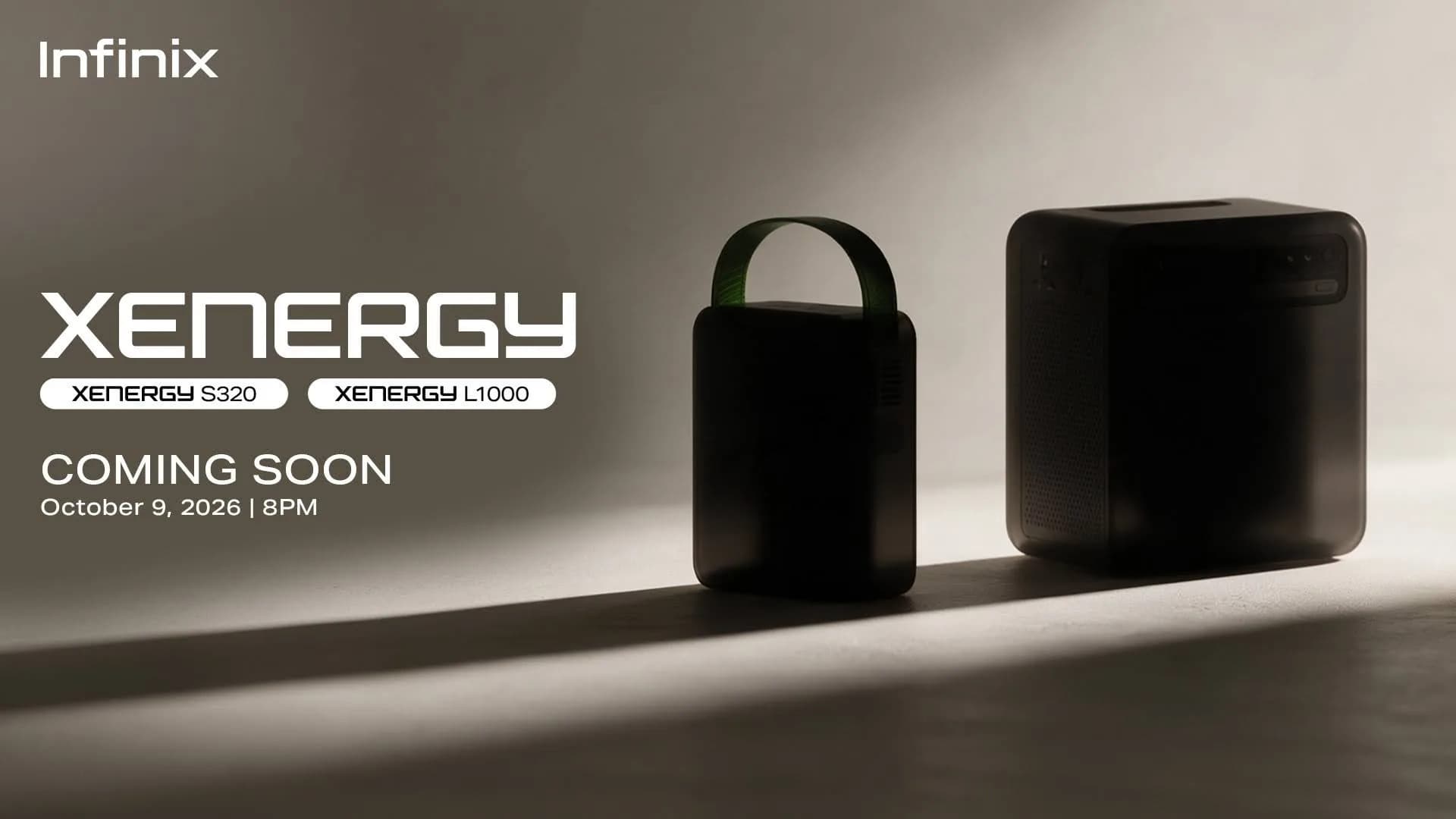
On paper, Infinix's ₱16,999 XENERGY L1000 can keep a 10W Wi-Fi router running for up to 100 hours of brownouts (1,000Wh ÷ 10W, before conversion losses), and refilling it costs about ₱15 at Meralco's latest published rate. It is the bigger of two portable power stations Infinix launched in the Philippines on October 10, alongside the ₱6,999 XENERGY S320. The suggested retail prices were first reported by Manila Shaker on launch day, and Technobaboy's launch report adds the launch promo prices: ₱5,999 for the S320 and ₱13,999 for the L1000 for now. With Meralco's all-in residential rate sitting at ₱14.7424 per kilowatt-hour and a distribution-rate increase just approved, this guide works out what each unit can actually run, what a full charge costs, and whether the money goes further with an EcoFlow or Anker instead.
One caveat up front: Infinix's own launch post on its Philippine Facebook page sits behind a login wall, so every figure below comes from the launch-day coverage and the pre-launch teasers, cross-checked where they overlap.
What Infinix launched, and what it costs
The two units cover different jobs.
- XENERGY S320 — a 320Wh (100,000mAh) portable unit weighing 3.3 kg, meant for phones, laptops and small devices at home, outdoors or while travelling. ₱6,999 SRP, ₱5,999 launch promo.
- XENERGY L1000 — a 1kWh (1,000Wh) home unit with a 500W rated output and a built-in UPS (uninterruptible power supply) that switches to battery in under 20 milliseconds when the grid drops. ₱16,999 SRP, ₱13,999 launch promo.
Both use LiFePO₄ (lithium iron phosphate) cells, a battery chemistry chosen for long cycle life rather than the lightest weight. Infinix rates the S320 for more than 3,000 charge cycles and the L1000 for more than 6,000, with a claimed ten-year service life for each, per Manila Shaker's spec rundown.
On where to buy, the two launch reports differ slightly. Technobaboy says both are sold through Infinix's official Shopee, Lazada and TikTok Shop stores and at Infinix stores nationwide, with a one-year warranty covering free repair or replacement for quality issues. Manila Shaker lists the S320 on Shopee and the L1000 on Lazada, so check both marketplaces if one listing is missing. Neither report gives an end date for the promo prices.
The launch itself was teased a week earlier. Gadget Pilipinas reported on October 6 that Infinix had not shared pricing ahead of the October 10 date, and YugaTech's teaser and GizGuide's carried the same headline specs: 500W output and a sub-20ms UPS for the L1000, 320Wh and 3.3 kg for the S320.
Infinix XENERGY S320 and L1000 specs side by side
| XENERGY S320 | XENERGY L1000 |
|---|
| Battery | 320Wh (100,000mAh) LiFePO₄ | 1,000Wh (1kWh) LiFePO₄ |
| Rated AC output | Not published (has an AC port) | 500W, two AC outlets |
| USB-C | 65W (launch reports) / 100W PD (pre-launch teaser) | 1 port, 5V/3A (up to 15W) |
| USB-A | 3 ports | 2 ports |
| DC barrel (5521) | 4 ports | 2 ports, 12V/5A (up to 60W) |
| Solar input | Up to 100W | Up to 400W |
| AC input / charge time | Not stated | Up to 1,000W; about 1 hour from 0–100% on AC, about 2.5 hours on solar (claimed) |
| UPS switchover | Not stated | Under 20ms |
| Cycle life (claimed) | 3,000+ | 6,000+ |
| Noise | Under 30dB | Under 45dB |
| Weight | 3.3 kg | Not published |
| Extras | LED light with three brightness levels and an SOS flash mode | Smart LED screen showing battery level, input and output |
| Warranty | 1 year | 1 year |
| Price | ₱6,999 SRP (₱5,999 promo) | ₱16,999 SRP (₱13,999 promo) |
Two gaps matter. The S320's AC output rating has not been published in any of the launch coverage, so there is no way to know yet which plug-in appliances it can run. And the USB-C figure conflicts: Unbox PH's pre-launch teaser described a 100W USB-C PD port, while both launch-day reports say 65W. Until Infinix publishes a spec sheet, assume 65W.
How long will they really run?
Infinix's own runtime figures, as relayed by Technobaboy, are:
- L1000: a 65W laptop for up to 15.38 hours, a 16W fan for 62.5 hours, a 10W bulb for 100 hours, a 15W LED TV for 66.66 hours, a 6W USB speaker for 166.66 hours.
- S320: a 20W phone charge for 16 hours, a 65W laptop for 4.9 hours, a 10W bulb for 32 hours, a 15W LED TV for 21.3 hours, a 6W USB speaker for 53.3 hours.
It is worth checking where those numbers come from. Divide capacity by load: 1,000Wh ÷ 65W = 15.38 hours, and 320Wh ÷ 20W = 16 hours. Every figure on the list is simply the battery's full rated capacity divided by the device's wattage. That assumes the battery delivers 100 percent of its capacity with no conversion loss. In practice the inverter that turns battery DC into 220V AC consumes some power itself, and no battery delivers its full rating to the socket, so treat Infinix's figures as ceilings, not promises. Devices charged over USB skip the inverter and will land closer to the claim than anything plugged into the AC outlets.
The same arithmetic sets the upper bound at full load. Run the L1000 at its 500W rating and 1,000Wh ÷ 500W gives two hours at best. Anything with a rating label above 500W will not run on it at all, so check the label on the appliance before counting on it.
What a full charge costs at Meralco's rate
Meralco's latest published all-in residential rate is ₱14.7424 per kWh for September 2026, down ₱0.0409 from August, according to Meralco's own advisory. The October advisory had not been published at the time of writing. On that rate:
- L1000: 1.0 kWh × ₱14.7424 = about ₱14.74 per full charge.
- S320: 0.32 kWh × ₱14.7424 = about ₱4.72 per full charge.
- Refilling an empty L1000 every day for 30 days: 30 × ₱14.74 = about ₱442 a month.
Those are floors. Charging draws more from the wall than the battery stores, and Infinix has not published a charging efficiency figure, so budget slightly more.
Two other costs are worth lining up against that. Spread the hardware over the claimed cycle life and the L1000 works out to ₱16,999 ÷ 6,000 = about ₱2.83 per cycle at SRP; the S320 is ₱6,999 ÷ 3,000 = about ₱2.33. Those cycle counts are Infinix's claims, not independent test results. And the grid price is about to move: the Energy Regulatory Commission has approved Meralco's first distribution-rate increase in 15 years, from ₱1.35 to ₱1.48 per kWh, Rappler reported on October 10. Rappler notes that a household using 200 kWh already pays nearly ₱2,950 a month at the September rate, and that neither Meralco nor the ERC has said when the new charge will show up on bills.
The practical point: a power station does not lower a Meralco bill. It only shifts when you draw the electricity, and you pay for the same energy plus the losses. The only way these units reduce grid use is solar input, which is where the L1000's 400W and the S320's 100W solar ceilings come in. Infinix has not listed its own panel in the launch coverage, and compatibility with third-party panels is not confirmed.
How XENERGY prices compare with EcoFlow and Anker in the Philippines
Prices below were checked on October 11, 2026. Anker's units are from anker.ph, which describes itself as Anker's official Philippine distributor. The EcoFlow units are from Altitude Philippines, a local retailer whose listings carry a two-year local supplier warranty on the River 3; it is not EcoFlow's own storefront. Sale prices change often, so treat these as a snapshot.
Around the S320's size (245–320Wh)
| Model | Capacity | AC output | UPS | Weight | PH price (regular) |
|---|
| Infinix XENERGY S320 | 320Wh | Not published | Not stated | 3.3 kg | ₱6,999 SRP (₱5,999 promo) |
| EcoFlow River 3 | 245Wh | 300W, 600W surge, 1 outlet | Under 20ms | 3.5 kg | ₱14,190 (₱14,990) |
| EcoFlow River 3 UPS | 245Wh | 300W, 600W surge, 1 outlet | Under 10ms | 3.5 kg | ₱12,590 (₱15,590) |
| Anker SOLIX C300 DC | 288Wh | None — DC only, 300W total, 140W USB-C | — | About 3.7 kg | ₱12,990 (₱14,990) |
| Anker SOLIX C300 AC | 288Wh | 300W, 600W surge, 3 outlets | 10ms | Not listed | ₱15,990 (₱18,890), sold out |
Per watt-hour of storage at SRP, the S320 costs about ₱21.87 (₱18.75 on promo). The River 3 is about ₱57.92 per Wh, the River 3 UPS about ₱51.39, the C300 DC about ₱45.10 and the C300 AC about ₱55.52.
Around the L1000's size (572–1,024Wh)
| Model | Capacity | AC output | UPS | Solar input | Warranty | PH price (regular) |
|---|
| Infinix XENERGY L1000 | 1,000Wh | 500W, 2 outlets | Under 20ms | Up to 400W | 1 year | ₱16,999 SRP (₱13,999 promo) |
| EcoFlow River 3 Max | 572Wh | 600W, 1,200W surge, 3 outlets | Under 10ms | 220W | 5 years (main unit) | ₱26,990 (₱29,990) |
| Anker SOLIX C1000 Gen 2 | 1,024Wh | 2,000W, 3,000W surge | Under 10ms | Up to 600W | 5 years | ₱39,990 (₱43,990) |
Per watt-hour, the L1000 is about ₱17.00 at SRP (₱14.00 on promo), against about ₱47.19 for the River 3 Max and ₱39.05 for the C1000 Gen 2.
That gap is the whole story. Infinix is selling storage at roughly a third of what the established brands charge per watt-hour. What you give up is everything around the battery: the L1000's 500W output is a quarter of the C1000 Gen 2's 2,000W, its switchover is twice as slow as the EcoFlow and Anker units' sub-10ms figures, its warranty is one year against two to five, and the S320 ships without a published AC rating. Anker also lists a 49-minute AC recharge for the C1000 Gen 2 with its HyperFlash mode and a 1,600W AC input, while Infinix claims about an hour for the L1000 at up to 1,000W.
Which one should you buy?
- Get the S320 if your brownout plan is phones, a laptop, a fan and a light for a few hours, and you want the cheapest storage per peso. At ₱6,999, nothing on the list comes close. But if you need to run anything through the AC outlet, wait for Infinix to publish the AC rating or pay more for a River 3 or C300 AC with a known 300W figure.
- Get the L1000 if you want a router, a work laptop and a fan to stay up through a long outage, or you want a UPS for a desktop or a POS terminal. Its 1kWh at ₱16,999 undercuts the half-capacity River 3 Max by ₱10,000. Remember the 500W ceiling.
- Look at the C1000 Gen 2 instead if you need more than 500W. It costs ₱39,990, but it is the only unit here that will run a load the L1000 cannot.
- Pay the EcoFlow or Anker premium if the gear behind the UPS is sensitive and you want the faster sub-10ms switchover, or if a one-year warranty on a battery you plan to cycle daily makes you uneasy.
- Buy nothing if the goal is a lower electricity bill. None of these units does that without panels.
Before you check out
- Decide whether the 65W-versus-100W USB-C question matters to your laptop. The launch reports say 65W; the earlier teaser said 100W.
- The L1000's weight has not been published. It is a home unit, not something to assume you can carry easily.
- The promo prices have no stated end date. Technobaboy's report says the units are sold through Infinix's official Shopee, Lazada and TikTok Shop stores and Infinix stores nationwide; buying from an official store is the simplest way to be sure the one-year warranty applies.
- Infinix claims the L1000 refills in about an hour on AC, but only with an input of up to 1,000W. On a shared extension cord during a scheduled brownout window, that is a heavy draw; plug it directly into a wall socket.
- If you intend to add solar, confirm panel compatibility with Infinix first. Branded panels are not cheap: Anker's 100W PS100 lists at ₱11,290 on anker.ph, and the solar ceiling on the S320 is only 100W.