Appistoki, a Salesforce consulting firm owned by Philippine technology company Novare, is spending the next two to three years chasing midmarket Philippine businesses with agentic AI — software agents that can carry out multi-step tasks such as answering customers or qualifying sales leads on their own. And according to its chief executive, the things slowing Filipino companies down are not what most people assume.
The two real blockers: messy data and unpredictable pricing
Appistoki founder and CEO Abhijeet Kulkarni says employee resistance is not the main obstacle to agentic AI adoption in the Philippines. The first real problem is data quality: many companies need to invest in integrating and harmonizing their records before an AI agent can work reliably on top of them. An agent that draws on incomplete or conflicting customer data produces incomplete or conflicting answers.
The second is cost predictability. Much of today's AI is billed by token consumption — a token being a small chunk of text the AI processes — and usage-based bills are hard to forecast. For a midmarket firm with a fixed technology budget, not knowing whether next month's AI bill will double is a genuine barrier, separate from whether the technology works.
On jobs, Kulkarni argues the technology is more likely to create new roles than cut headcount, pointing to positions such as forward-deployed engineers — technical staff who work inside a client's business to make AI deployments succeed.
Why the Philippine midmarket
The Philippines is already Appistoki's center of gravity: the company generates 70 percent of its Southeast Asian revenue here, operating alongside its Singapore business. Kulkarni cites English proficiency, low barriers to doing business, and companies' willingness to work with vendors as reasons to go deeper into the market. The acquisition by Novare, completed over a year ago, gave Appistoki access to a larger client base, more than 200 data engineers, and capabilities beyond the Salesforce platform. The firm was also among the first Salesforce partners to integrate with the Viber messaging app, a fixture on Filipino phones.
A showroom for AI agents in BGC
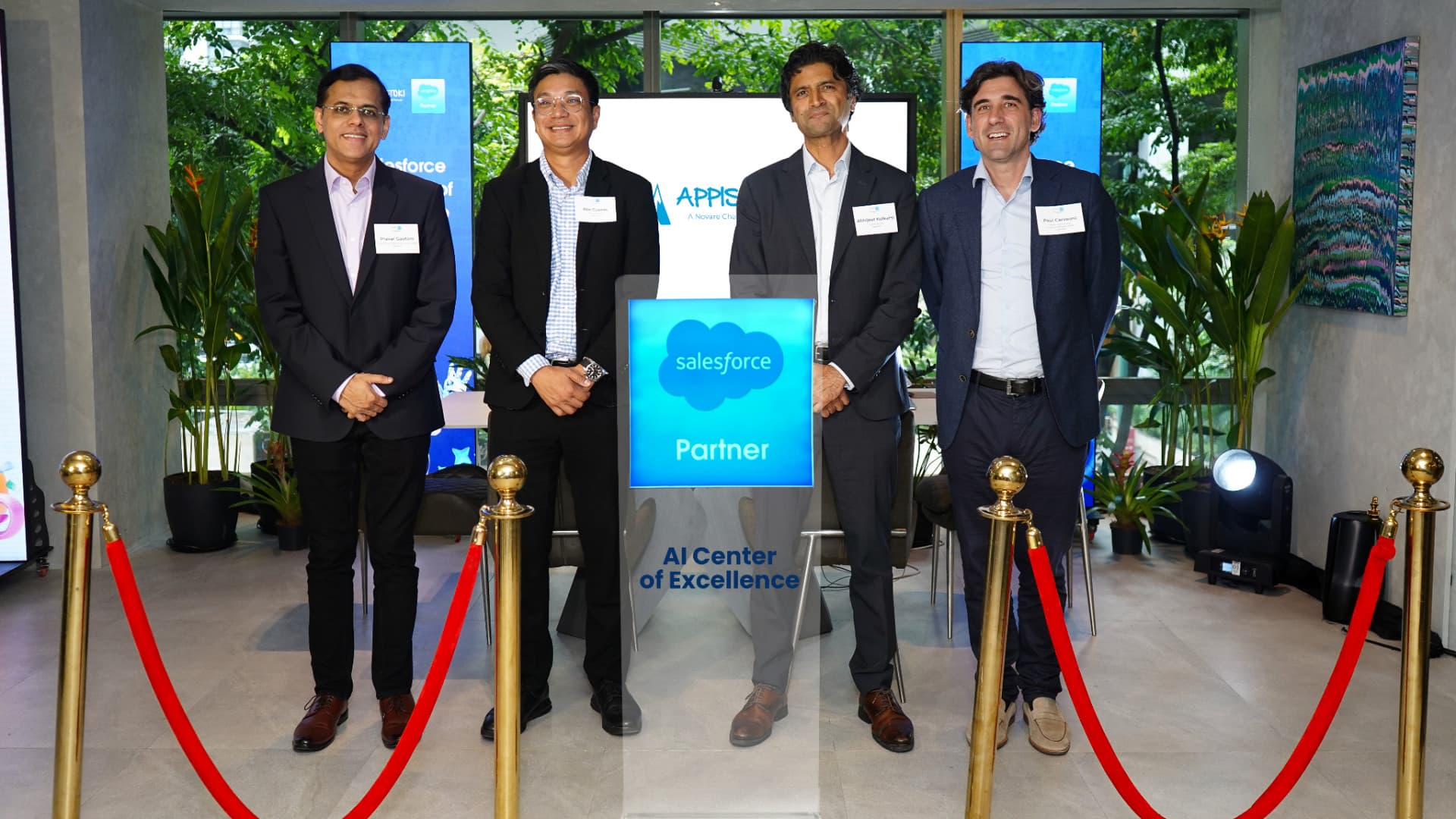
The push is anchored on the Salesforce Data and AI Center of Excellence that Appistoki launched at Novare's Bonifacio Global City headquarters on August 27. The facility is a working demonstration space for Agentforce, Salesforce's agentic AI platform, and Data 360, its data engine, hosting customer briefings, workshops, and co-development sessions.
Appistoki is targeting at least 150 client appointments at the center within its first year; three companies had booked sessions shortly after it opened. The initial focus is real estate — lead engagement, property recommendations, and AI-assisted customer support — with financial services and possibly hospitality to follow.
The property focus is deliberate. Real estate accounts for about 5 percent of Philippine GDP and expanded 6.8 percent year-on-year in the first quarter of 2026. Ayala Land chief information officer Roscoe M. Pineda, an existing client, put it this way at the launch: "We're taking that journey to the next level — using AI on top of the data we've built on Salesforce."
Salesforce's ASEAN senior vice president and general manager Paul Carvouni framed the stakes more broadly: "Business success in the Philippines will be defined by organizations that move beyond AI pilots to apply AI where it delivers measurable outcomes." Novare CEO Victor Silvino said the goal is "purposeful and enterprise-ready AI solutions for Filipino companies."
What this signals for Philippine businesses
Agentic AI in the Philippines has so far been a story about the biggest institutions — PLDT has put three agentic AI agents to work on internal processes, and Maya cut customer onboarding time by 84 percent using national ID verification and agentic AI. A systems integrator restructuring its whole strategy around midmarket firms suggests the vendors now see the next wave of demand below the enterprise tier — among companies large enough to have real customer data, but without the IT departments of a telco or a bank.
For those firms, Kulkarni's two blockers double as a checklist: clean up the data first, and pin down the pricing model before signing. The technology, on this account, is the easy part.