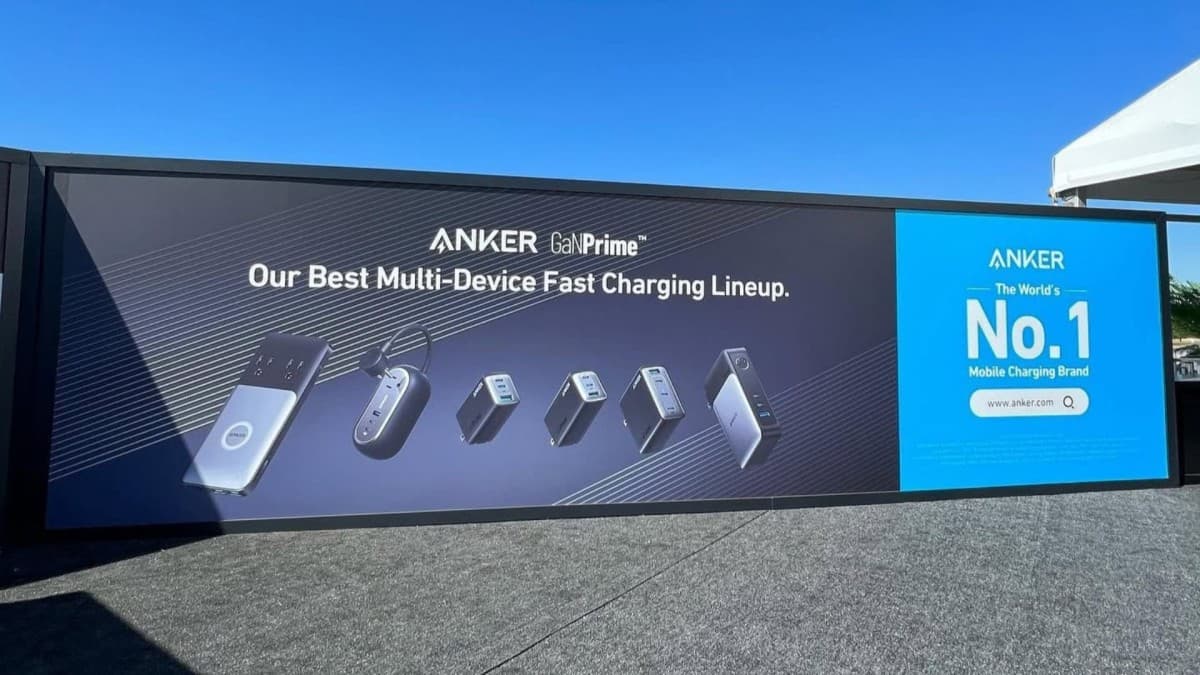
In a candid prediction that drew attention across the tech industry, Anker Innovations founder and CEO Steven Yang warned that portable power banks — the product category that built Anker into a global brand — could become obsolete within a few years. Speaking at Anker's 2025 annual meeting, Yang compared the trajectory of external batteries to transitional technologies like cassette players, MP3 devices, and CD players: once essential, eventually made redundant by improvements in the hardware they supported.
The Core Argument: Bigger Batteries, Less Need for Accessories
Yang's reasoning centers on a straightforward trend: smartphone batteries are growing rapidly, and silicon-carbon battery chemistry is accelerating that growth. Devices like the realme P4 series and the HONOR Win Turbo have already crossed the 10,000mAh threshold — approaching or matching the capacity of the power banks most users carry. As built-in battery sizes climb and fast-charging speeds improve, Yang believes the primary use case for carrying a separate external battery will simply evaporate for most consumers.
Modern processors and software optimization are also reducing daily energy consumption, extending how long phones last on a single charge. Combined with ever-faster wired and wireless charging, the window in which someone genuinely needs an external battery is narrowing.
Anker's Own Role in the Overextension
Yang's comments came with a degree of self-criticism. At the 2025 annual meeting, Anker acknowledged producing far too many power bank models — approximately 100 different variants in 2024 alone. Yang cited this as evidence that the category had become unfocused. Offering nearly 100 models of a single product type suggests a company reaching for market coverage at the cost of coherent product strategy.
Despite the sobering forecast, Anker's overall business remains substantial. The company generated over 15 billion yuan from charging and energy storage products in 2025. However, power banks are no longer the primary revenue driver: charging accessories and energy storage systems together account for roughly half of total revenue, with the remainder spread across other categories.
Diversification Is Already Underway
Anker has been expanding well beyond power banks for several years, and Yang's remarks suggest the company intends to accelerate that shift:
- Soundcore audio — earbuds and headphones under the Soundcore sub-brand have become a meaningful growth segment
- Portable power stations — larger energy storage products aimed at outdoor use, camping, and emergency home backup
- Multi-port GaN chargers — wall adapters and desktop charging hubs remain in strong demand
- PC peripherals — hubs, docks, and cables
- Smart home devices — a newer entry point for Anker
The diversification is not merely a hedge; Yang frames it as a necessary evolution for a company that cannot rely on a single product category as phone hardware continues to improve.
Will Power Banks Disappear Entirely?
Yang's prediction carries important nuance. The category may not vanish entirely — emerging devices including foldable phones, XR headsets, tablets, and portable AI hardware will continue to create demand for supplemental power solutions. What is likely to shrink or change is the mass-market, general-purpose portable charger: the basic power bank sold by the millions as a universal accessory.
What survives may be more specialized: ultra-high-capacity power stations for outdoor use, MagSafe-style clip-on accessories for quick wireless top-ups, and niche solutions for professionals who need guaranteed uptime. But the era of the power bank as a must-have everyday accessory may indeed be fading — and few are better positioned to see it than the man whose company helped create that era.
Sources: