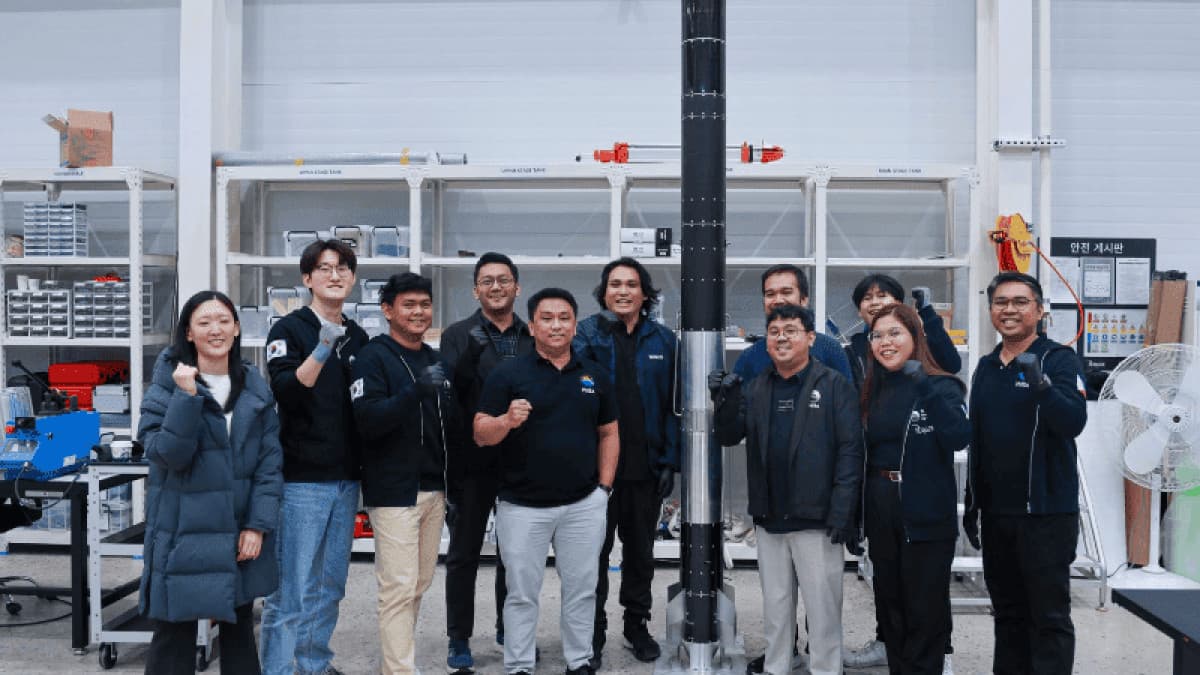
The Philippines has set a date for its first rocket launch from its own soil. The Philippine Space Agency (PhilSA) is targeting a liquid-fueled sounding rocket flight from Cagayan in 2027, carrying a locally developed payload of up to 2 kilograms to an altitude of at least 5 kilometres.
President Ferdinand Marcos Jr. announced the plan in his State of the Nation Address on July 27. "A sounding rocket launch test is slated for next year. Yes, we are going to launch a rocket into space," he said, as reported by Back End News.
The claim needs a careful reading, and the agencies involved have been more precise than the soundbite.
What a sounding rocket actually is
A sounding rocket is a small research rocket. It flies straight up, spends a few minutes above the atmosphere or in the upper atmosphere, and falls back — it does not enter orbit and cannot place a satellite in orbit.
NASA describes typical sounding rocket flights as spending roughly 5 to 20 minutes above the atmosphere. The Philippine demonstration is deliberately modest: 2kg of payload, 5km of altitude. That is a test of the launch system and the ground operations, not a satellite mission.
Liquid-fueled is the harder part and the reason this matters technically. Solid-fuel rockets are simpler; a liquid-propellant engine involves pumps, valves, cryogenic or storable propellants, and a throttle-and-shutdown capability. Building operational experience with liquid propulsion is the step that leads somewhere, which is why it was chosen over an easier demonstration.
Who is building it
Five organisations are named on the project:
- PhilSA — leading the effort
- Department of Information and Communications Technology (DICT)
- Cagayan Economic Zone Authority (CEZA)
- Ascend International Gateway Inc. — the Philippine airport operator
- Perigee Aerospace Inc. — a South Korean aerospace company
The partners signed a memorandum of understanding in March 2026. The technical groundwork started earlier: Filipino engineers trained with Perigee in South Korea from October to November 2025, working hands-on with the company's Blue Whale 0.1 liquid-propellant sounding rocket platform, Newsbytes.PH reported.
The launch site is planned for Lal-lo, Cagayan, at the Cagayan North International Airport.
Why Cagayan
The site choice is geography, not politics. PhilSA Director General Gay Jane Perez laid out the reasoning: "With the Pacific Ocean to its east and its proximity to the equator, the Philippines is well positioned for safe and secure rocket launch and recovery operations."
Both factors are real advantages:
- Open ocean to the east means spent stages and failed launches fall into water, not over populated land. This is the single biggest constraint on where anyone can legally launch.
- Proximity to the equator gives a rocket extra speed for free from the Earth's rotation — worth more the closer you are to 0° latitude. It is why launch sites cluster near the equator worldwide.
Marcos framed Cagayan as "both geographically and economically primed to serve as our gateway to space and host the country's first spaceport."
What it would be for
DICT Secretary Henry Aguda tied the capability to a concrete national need: an independent launch capability would let the Philippines deploy its own communications satellites and Earth observation systems rather than buying rides from other countries.
Earth observation is the part with the clearest domestic payoff. A country that gets hit by roughly twenty typhoons a year, and that manages large agricultural and maritime areas, has a permanent appetite for imaging data — and currently depends on foreign providers and partnerships for most of it.
There is also a commercial argument. Asia's launch infrastructure is concentrated in a few countries, and PhilSA has been explicit that a Cagayan spaceport is meant for commercial use, potentially attracting operators who want an equatorial site with Pacific range safety.
The honest assessment
A 5km sounding rocket is a long way from orbital launch, and nobody involved has claimed otherwise. The gap between "we flew 2kg to 5km" and "we put a satellite in orbit" is measured in years and in orders of magnitude of energy.
It has drawn political pushback on priorities. Senator Robin Padilla questioned whether space exploration should rank above infrastructure such as rail projects — a fair question in a country where the same SONA also pushed for EPIRA amendments to cut electricity bills.
What the 2027 flight would genuinely deliver is narrower but not trivial: a trained cohort of Filipino propulsion and range-safety engineers, a working launch site with real operating procedures, and a locally built payload that flew. That is the sort of capability that also shows up in adjacent government tech work, from satellite data handling to the DICT's ongoing push to put more agencies onto shared digital platforms.
The date to watch is early 2027. Until a rocket is on the pad in Lal-lo, this remains a plan with a signed MOU and a trained team behind it — which is further along than most national space ambitions get, and still short of a launch.