Moonshot AI has released the weights for Kimi K3, making the largest open-weight AI model yet published free to download. The files went up on Hugging Face over the weekend of July 26 and 27, a week after the model itself was announced.
"Open weights" is not the same as open source. It means the trained numbers that make up the model are published, so anyone can download them and run the model on their own hardware, instead of only calling it through Moonshot's paid service. What you cannot necessarily do is whatever you like with it — that depends on the licence attached.
The specifications
| Item | Kimi K3 |
|---|
| Total parameters | 2.8 trillion |
| Active parameters per token | About 50 billion (16 of 896 experts) |
| Context window | 1,048,576 tokens (1M) |
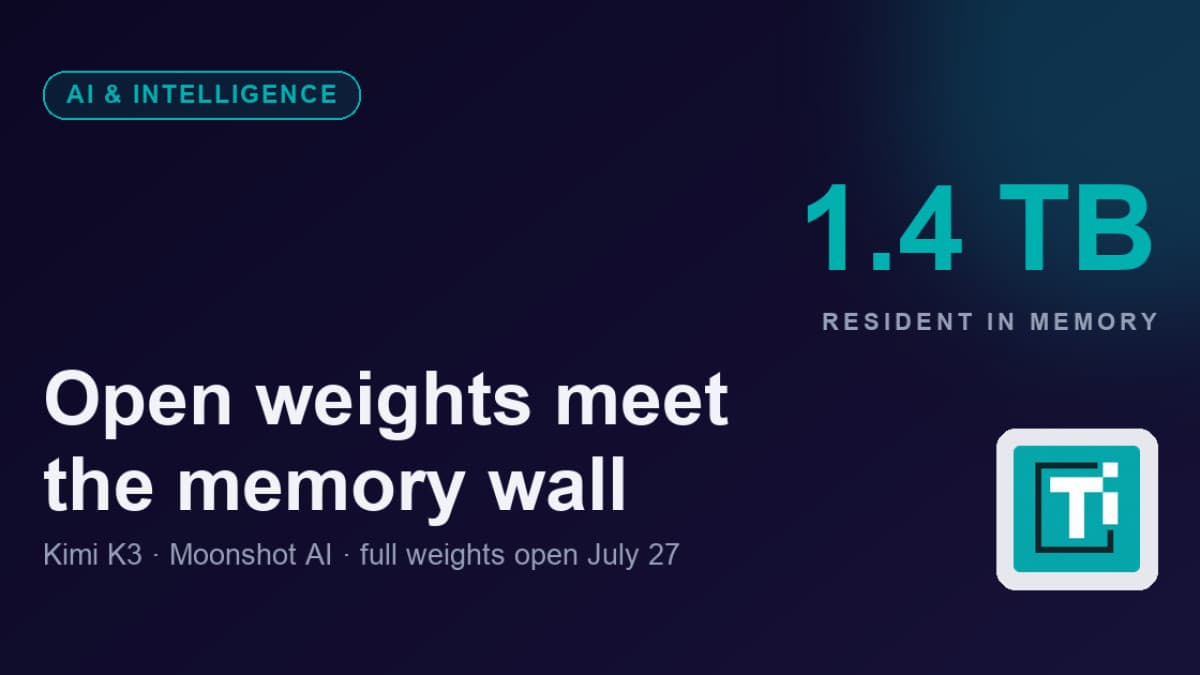
| Download size, 4-bit (MXFP4) | About 1.4 terabytes |
| Size at 16-bit precision | About 5.6 terabytes |
The model uses a mixture-of-experts design, which means it does not run all 2.8 trillion parameters for every word it processes. It routes each token to a small subset — 16 of 896 internal "experts" — so the compute cost per token behaves more like a 50-billion-parameter model. The catch is memory: even unused experts must be loaded, so the full 1.4 terabytes has to sit in fast memory regardless.
Why almost nobody can run it at home
This is the part that gets lost when a model is called "free." TECHi's analysis of the release put the hardware requirement bluntly: holding 1.4 terabytes of weights implies roughly eighteen 80-gigabyte accelerators just to load the model before a single user query is served. The realistic targets are Nvidia Blackwell and AMD MI400 class hardware.
That puts self-hosting out of reach for individuals and most companies. The organisations that gain from an open-weight release at this scale are inference providers, large enterprises already running racks of accelerators, and cloud platforms — not a developer with a workstation.
How good is it
Independent evaluations put Kimi K3 near the top of the field rather than at it. Writing before the weights dropped, AI researcher Nathan Lambert called it "the strongest open model ever released," and the closest an open-weight model has come to frontier performance since DeepSeek R1. Third-party indexes rank it second on one intelligence benchmark and third on another, behind closed frontier models, while placing it first on frontend-coding tasks.
One caveat is worth flagging. Reporting ahead of the release noted that commercial usability could not be confirmed until Moonshot published the licence alongside the weights — so anyone planning to build a product on K3 should read the licence file on the official Moonshot repository rather than assume it permits commercial use.
What this means for developers in the Philippines
For a Filipino developer or startup, the open weights are largely symbolic — the practical route is still the paid API, and there is no local price list. Kimi K3 is billed in US dollars everywhere, at about $3.00 (around ₱185) per million input tokens on a cache miss, $0.30 (around ₱19) per million on a cache hit, and $15.00 (around ₱930) per million output tokens, using a rate of roughly ₱61.80 to the dollar. Consumer plans for the web app start at about $19 a month (around ₱1,170).
Two practical notes follow. First, paying in dollars on a Philippine card means your bank's foreign exchange spread is part of your real cost. Second, no Philippine government restriction on the service has been announced — unlike the Chinese access restrictions that hit Claude earlier this year — though teams handling regulated or personal data should weigh where the inference actually runs before routing production traffic to any overseas provider.
The more durable effect is on price. Every capable open-weight release gives cloud providers something to host and compete on, and that pressure tends to reach smaller markets as cheaper per-token rates — which is how a 1.4-terabyte download nobody in Manila will run still ends up mattering here.