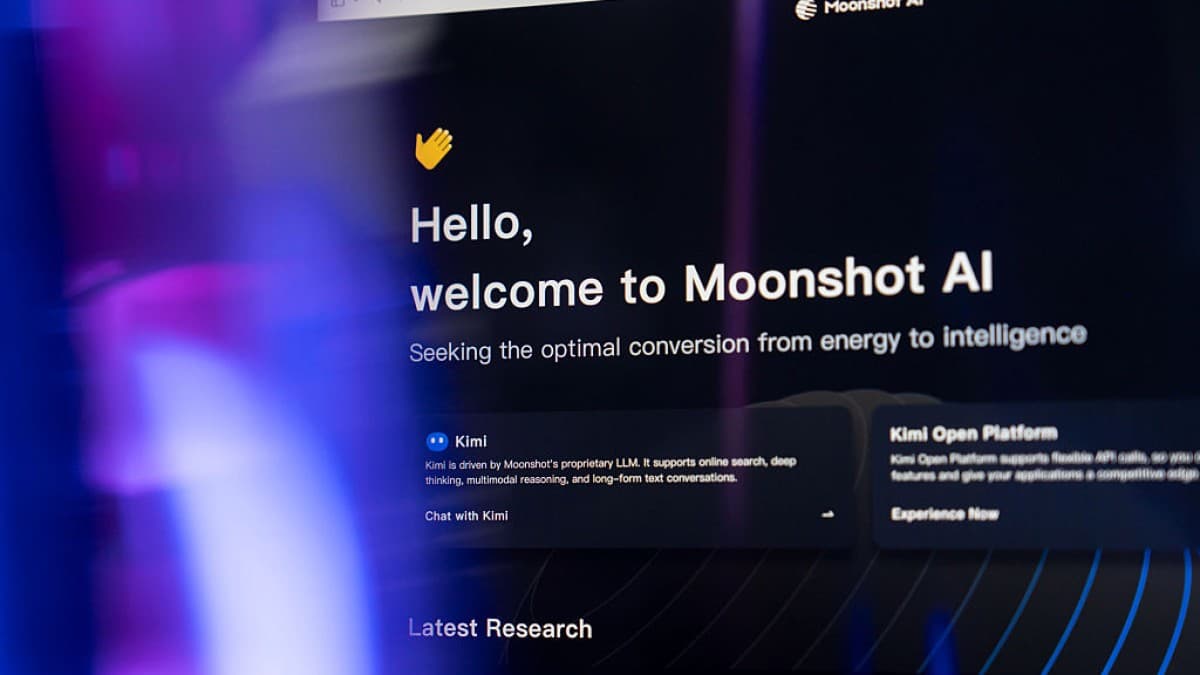
Kimi K3, the new flagship model from Beijing-based Moonshot AI, is the largest open-weight AI model released so far — and its arrival was big enough to move stock markets. The model carries 2.8 trillion parameters, ranks near the top of several independent benchmarks, and will have its full weights published on July 27 under a modified MIT licence. On the first full trading day after the launch, the Nasdaq fell about 1.5%, Taiwan's benchmark index dropped more than 6%, and Japan's market closed down 4%.
What Kimi K3 actually is
K3 is a Mixture-of-Experts model, or MoE — an architecture that holds a very large number of specialised sub-networks ("experts") but activates only a few for each token of text, so it runs far cheaper than its raw size suggests. Moonshot says K3 holds 896 experts and activates 16 per token.
The headline specifications:
- 2.8 trillion total parameters, with only a small fraction active per token
- Up to a 1 million token context window — roughly the length of several full-length books in a single conversation
- Native vision input, so it reads images as well as text
- Built on Kimi Delta Attention, Moonshot's hybrid linear attention method
- Full weights on July 27 under a modified MIT licence, meaning anyone can download, self-host and fine-tune it
One discrepancy worth flagging: Fortune reported the model at 2.7 trillion parameters, while most other coverage and Moonshot's own figures put it at 2.8 trillion. The 2.8 trillion number is the one Moonshot has published.
How it performs against US models
On the Artificial Analysis Intelligence Index, K3 scored 57 — competitive with Anthropic's Claude Opus 4.8 and OpenAI's GPT-5.5, and close to the current frontier models at a much lower price. Independent evaluations placed it near the top rather than at it: third overall on GDPval-AA v2, a benchmark that scores real-world tasks across 44 occupations, and second on AA-Briefcase, a private agentic benchmark for long-horizon knowledge work. Less than a day after release it took first place on Arena AI's front-end programming leaderboard.
Moonshot's own comparisons are more modest than the hype around them: the company says K3 substantially beats Opus 4.8 and GPT-5.5, but still trails the very newest frontier releases.
Developer Simon Willison, who tested the model on release day, noted that K3 burns a lot of reasoning tokens — 13,241 of 16,658 output tokens in one test went to internal reasoning before the answer appeared. That matters for anyone paying per token.
Why chip stocks fell
The selloff followed a familiar script. When a Chinese lab ships a near-frontier model cheaply and openly, investors start questioning whether the enormous capital spending on AI data centres is necessary. Semiconductor shares led the drop across the US, Taiwan and Japan, and the VanEck Semiconductor ETF broke below a support level it had held since April.
Analysts were split on whether the reaction was justified. Morgan Stanley's Gary Yu said K3 "has received positive feedback globally, signaling an all-round catch-up of Chinese LLMs with U.S. leaders." Bernstein's Robin Zhu was cooler, calling the launch "confirmatory" of progress that was already expected rather than a genuine surprise. Markets recovered part of the loss quickly, which suggests investors had learned something from the DeepSeek scare of January 2025.
The political reaction was noisier than the market one. TechCrunch's roundup of the debate captured commentary ranging from claims that US regulation is holding domestic labs back, to arguments that the alarm is simply overblown.
What it costs — and whether Filipinos can use it
Kimi K3 is already live at kimi.com, in the Kimi mobile apps, and through Moonshot's API under the model ID kimi-k3. There is no Philippine-specific pricing or local partner, and no local launch has been announced.
API pricing is US$3 per million input tokens (around ₱185) and US$15 per million output tokens (around ₱920), using mid-July's rate of about ₱61.55 to the dollar. That is a sharp increase over Moonshot's previous K2.6 model, which charged US$0.95 and US$4 (around ₱58 and ₱246). It is still far below the roughly US$50 per million output tokens (around ₱3,080) charged by the top-tier Western model it is measured against. Consumer plans on kimi.com start at about US$19 a month, or roughly ₱1,170.
What this means for developers in the Philippines
The July 27 weights release is the part worth watching locally. An openly licensed model at this capability level means Philippine startups, universities and government units can run a near-frontier model on their own hardware or on a rented cloud instance, without sending data to a foreign API — a real consideration for anyone handling regulated data. The catch is scale: a 2.8-trillion-parameter model needs serious GPU capacity to self-host, so in practice most local teams will still reach it through an API. It arrives into an already crowded field, alongside OpenAI's staged GPT-5.6 rollout and the geopolitical friction that has already seen Anthropic block Chinese access to Claude.
Moonshot itself raised US$2 billion (around ₱123 billion) in May 2026 at a US$20 billion valuation (around ₱1.2 trillion), with annual recurring revenue reported above US$200 million (around ₱12.3 billion).