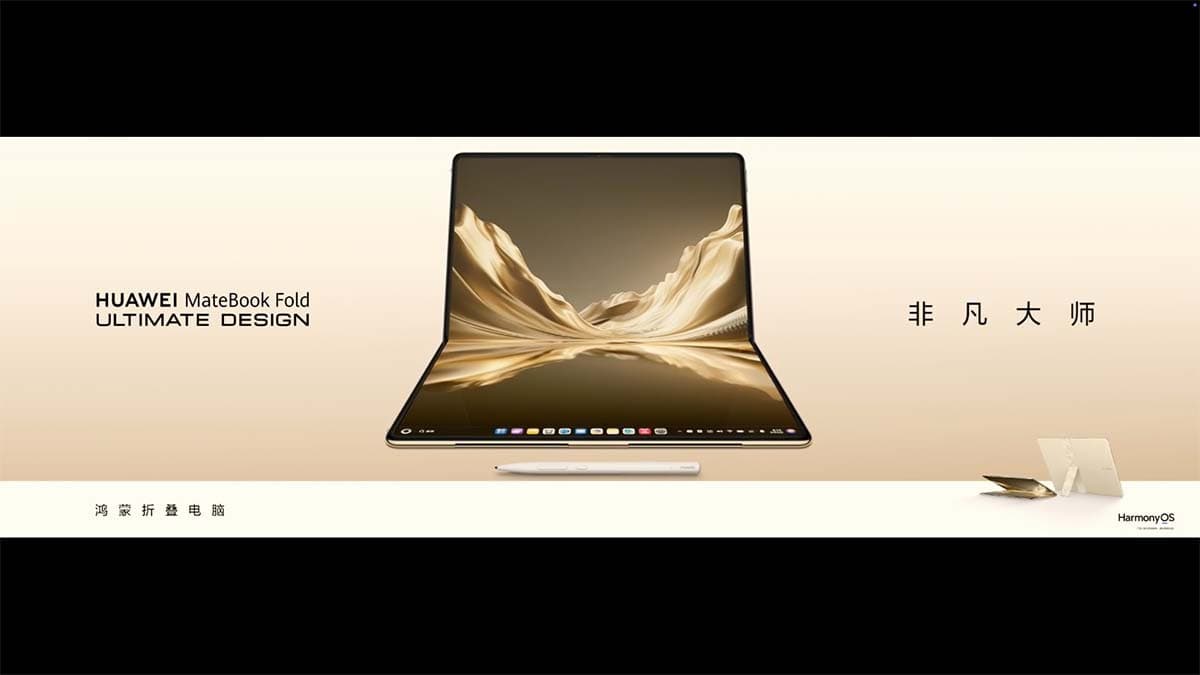
Huawei has launched the second generation of its MateBook Fold Ultimate Design, a laptop whose entire body is one 18-inch folding OLED screen. Announced on August 5 at the company's summer event in China, it moves to a new Kirin X90 Plus processor and still weighs just 1.16kg — less than most 14-inch aluminium laptops.
One screen that becomes three devices
The idea has not changed from the first generation. Open the machine flat and you get an 18-inch display. Fold it in half and it becomes roughly the footprint of a 13-inch laptop, with the lower half of the panel turning into a virtual keyboard and trackpad. A separate physical keyboard can be used with the screen fully open, and a built-in kickstand lets it stand on its own like a monitor.
Notebookcheck's report describes the panel as a dual-layer OLED at 3.3K resolution with up to 1,600 nits of peak HDR brightness, a 92 percent screen-to-body ratio and LTPO — a backplane technology that lets the refresh rate drop when the screen content is static, saving power.
The hinge is the part that decides whether a foldable survives daily use. Huawei has redesigned it as a waterdrop hinge — the shape that lets the panel curve rather than crease sharply — using zirconium-based liquid metal components. The rear is finished in silicone-coated vegan leather.
Kirin X90 Plus and HarmonyOS 6.1
The processor is the Kirin X90 Plus, Huawei's in-house PC chip. The company claims around 25 percent smoother performance than the previous generation at a 28W TDP — thermal design power, the sustained heat budget the cooling system is built around. An ultra-thin vapour chamber handles cooling.
Software is HarmonyOS 6.1, running tablet, laptop and desktop modes on the same machine. This is the crucial caveat for anyone outside China: HarmonyOS is not Windows and not macOS. It runs Huawei's own app ecosystem, and it will not run the Windows programs most Philippine offices and schools depend on.
Huawei also introduced a new AI-assisted M-Pencil stylus for handwriting, note-taking and sketching on the open panel.
Battery and charging
Huawei Central lists a 74.69Wh (6,400mAh) battery with 140W wired fast charging, and confirms the 1.16kg weight. There is an 8-megapixel camera above the display for video calls.
What it costs
| Configuration | China price | Rough peso equivalent |
|---|
| 24GB + 512GB | 24,999 yuan | around ₱225,000 |
| 24GB + 1TB | 26,999 yuan | around ₱243,000 |
| 32GB + 2TB | 29,999 yuan | around ₱270,000 |
Peso figures use about ₱9.00 to the yuan and are estimates. These are not local prices.
Should a Filipino buyer care?
Honestly, not as a purchase — at least not yet. Huawei announced the MateBook Fold Ultimate Design 2026 for China only, and there is no stated plan for a Philippine or wider international release. The first-generation model never had an official local launch either; units surfaced on Philippine e-commerce listings through importers and resellers, which means no local warranty and no local service support on a device whose most expensive part is a folding screen.
The reason to watch it anyway is what it signals about price and supply. A 1.16kg machine with an 18-inch panel at roughly ₱225,000 shows how far folding displays have come, and it lands while conventional laptops are getting harder to buy — the memory squeeze driving the MacBook Air shortage at Apple stores is the same shortage pushing up RAM and storage costs across the industry.
Folding glass is also arriving on the phone side, where Philippine buyers will meet it first. The iPhone 18 Fold hands-on report sets out what reviewers found the crease, the hinge and the weight are like in daily use — the same questions that decide whether an 18-inch folding laptop is a serious tool or an expensive demonstration.