The short version: the World Bank has rated the implementation of DICT's flagship $288.88-million (around ₱18.1 billion) broadband project "Moderately Satisfactory" — and the bidding for two key phases of the National Fiber Backbone has now failed twice.
The $289-million project in brief
The Philippine Digital Infrastructure Project (PDIP) is the government's biggest internationally financed push to close the country's connectivity gap. The World Bank's board approved $287.24 million (around ₱18 billion) in financing on October 10, 2024, with the Philippine government putting up a $1.64-million (around ₱103 million) counterpart — a total approved cost of $288.88 million.
According to the World Bank's project announcement, the money funds three layers of infrastructure:
| Layer | What it builds |
|---|
| National Fiber Backbone | Remaining segments linking international cable landing stations in Baler, Aurora and Davao City |
| Middle-mile network | Underground fiber to underserved regions across the Visayas and Mindanao |
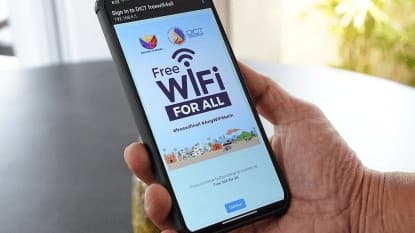
| Last-mile access | Connections for schools, hospitals, and public institutions, plus free Wi-Fi points |
The bank expects more than 20 million Filipinos to benefit — a large share of them in areas where private telcos have never built. When the project was approved, 45.5 percent of barangays had no private telecommunications service.
Two failed biddings for Phases 4 and 5
The problem is getting the work awarded. Philstar Tech reported that the design-and-build package for National Fiber Backbone Phases 4 and 5 has gone through two failed bidding rounds: the first bidding failed outright, and when the package was rebid, the lone bidder did not meet qualification standards.
The Department of Information and Communications Technology (DICT) says prospective bidders are "steadily adjusting" to the World Bank's qualification and technical requirements as they are aligned with Philippine market conditions. The project runs under the bank's mandatory international competitive procurement rules, which impose prescribed posting, evaluation, review, and clearance periods along with strict governance requirements — a slower, more demanding process than a purely domestic bid.
"There is a cost of money for delayed procurements"
Former DICT undersecretary Jeffrey Ian Dy read the rating as a mixed signal. "A 'Moderately Satisfactory' rating by the World Bank on project implementation is good, but it reveals there are areas for improvement," he said, adding that beyond the interest expense on the loan itself, there is "a cost of money for delayed procurements."
Despite the setbacks, DICT is keeping its target: the project — and the national fiber network it anchors — is still scheduled for completion by 2028.
Can the 2028 target hold?
For Filipinos in the unserved barangays this project is supposed to reach, the procurement calendar is the whole story: fiber that is not awarded cannot be built, and every failed bidding pushes real connectivity further out. The government is not short of parallel plans — the proposed 2027 national budget sets aside ₱531 billion for digitalization, including a major expansion of free public Wi-Fi — but PDIP is the piece meant to build the physical backbone those services ride on. A third bidding round for Phases 4 and 5 will show quickly whether "steadily adjusting" bidders translate into an actual award, and whether 2028 remains a deadline or becomes a moving target.