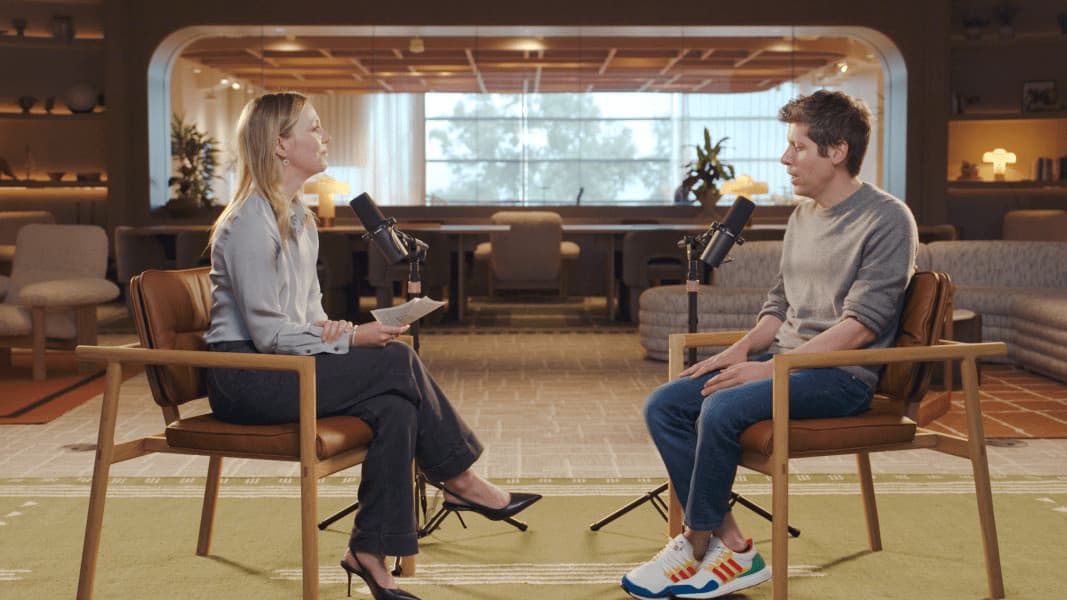
OpenAI will not go public in 2026. Chief executive Sam Altman ruled out an initial public offering (IPO — a company's first sale of shares to the public) this year in an interview with Fortune published September 12, saying safety work comes first.
"I actually think that, given everything happening with safety, right now would be an ill-advised moment to go public, and we don't feel pressure on that," Altman said. Asked whether that pushes a listing to 2027, he kept the door open without committing: "I would say not 2026. Yeah, we got a lot of stuff to do."
Safety first, listing later
Altman's reasoning was less about markets than about the models. He said society "needs to contend with these models at each level of capability," and that OpenAI may pause at new capability levels until safety work catches up. He acknowledged that AI going beyond human control is "absolutely" possible and that current safety standards are not yet adequate.
In remarks carried by Yahoo Finance via Reuters, he went further on the stakes, saying of extinction-risk estimates: "Whether it's 10 or eight or six, the point is, we all have a tremendous amount of responsibility, and cannot let egos or incentives for profit or anything else get in the way."
An industry pact to slow down?
The most consequential line in the interview may not be about the IPO at all. Altman suggested OpenAI and other leading AI companies "may be close to announcing a pact to slow AI development" and coordinate on safety — ideally, he said, with governments involved. Anthropic chief executive Dario Amodei has similarly called for a more deliberate pace. No such agreement has been announced yet, and none of the companies has published terms, so treat this as a signal rather than a done deal.
The timing is notable. OpenAI shipped GPT-6 Astra, a computer-use AI that does office work on its own, earlier this year — exactly the kind of increasingly autonomous system driving calls in the US Congress for new AI rules.
The money left on the table
Fortune's report notes a potential OpenAI listing has been discussed at valuations around $1 trillion (around ₱63 trillion), which would rank among the largest public companies on debut. For scale, the same Reuters-carried report points to SpaceX, whose valuation reached about $1.8 trillion (around ₱113 trillion) after its own market debut — proof that investor appetite for a marquee tech listing is not the constraint here. Delaying does not close that window; Altman's point is that the company does not need public capital badly enough to list during a safety reckoning. "We need to act such that we are not taking any of those numbers of risk, and I believe we can," he said of the industry's risk estimates.
Why Filipinos have a stake in this
Few countries use OpenAI's products as intensively as the Philippines. The country ranks sixth in the world in ChatGPT adoption, with 42.4% of Filipino internet users aged 16 and up having used the chatbot in the previous month, according to the Digital 2026 Overview Report by Meltwater and We Are Social cited by the Daily Tribune. A slower, safety-gated OpenAI — and a possible industry-wide pact to pump the brakes — would shape the pace at which new AI features reach those millions of Filipino users, from students to BPO teams. It also matters for the region's infrastructure math: OpenAI has been anchoring AI factories in Southeast Asia while the Philippines maps its own data-center plans. There is no Philippine-specific product change announced here — the local impact runs through how fast the global roadmap moves.