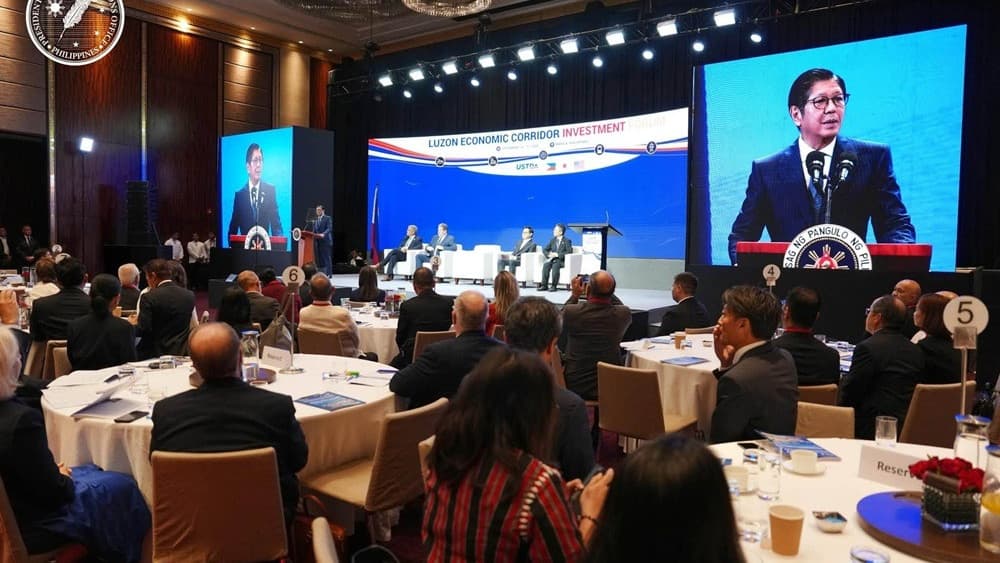
The inaugural Luzon Economic Corridor Investment Forum brought around 600 investors, business executives, and senior officials to the Grand Hyatt Manila in Taguig on September 10 and 11. President Ferdinand Marcos Jr. used the stage to pitch the corridor as the country's main vehicle for up to $70 billion (around ₱4.4 trillion) in potential investments and as many as 190,000 direct jobs. "Build your next enterprise in the Philippines. Bring your capital, technology, your expertise," Marcos told the room, as reported by Newsbytes.PH.
The two-day forum was co-hosted by the governments of the Philippines, the United States, and Japan, and organized with the US Trade and Development Agency (USTDA, the US agency that funds project preparation abroad). The US delegation was led by newly appointed Ambassador Lee Lipton, joined by USTDA Deputy Director Thomas Hardy, Finance Secretary Frederick Go, socioeconomic planning chief Arsenio Balisacan, and Japan's Chargé d'Affaires Ono Sho.
What the Luzon Economic Corridor promises
The corridor links Subic, Clark, Manila, and Batangas, and the forum focused on four areas: transportation, energy, digital infrastructure, and advanced manufacturing supply chains. Marcos called it "our strategy for organizing growth."
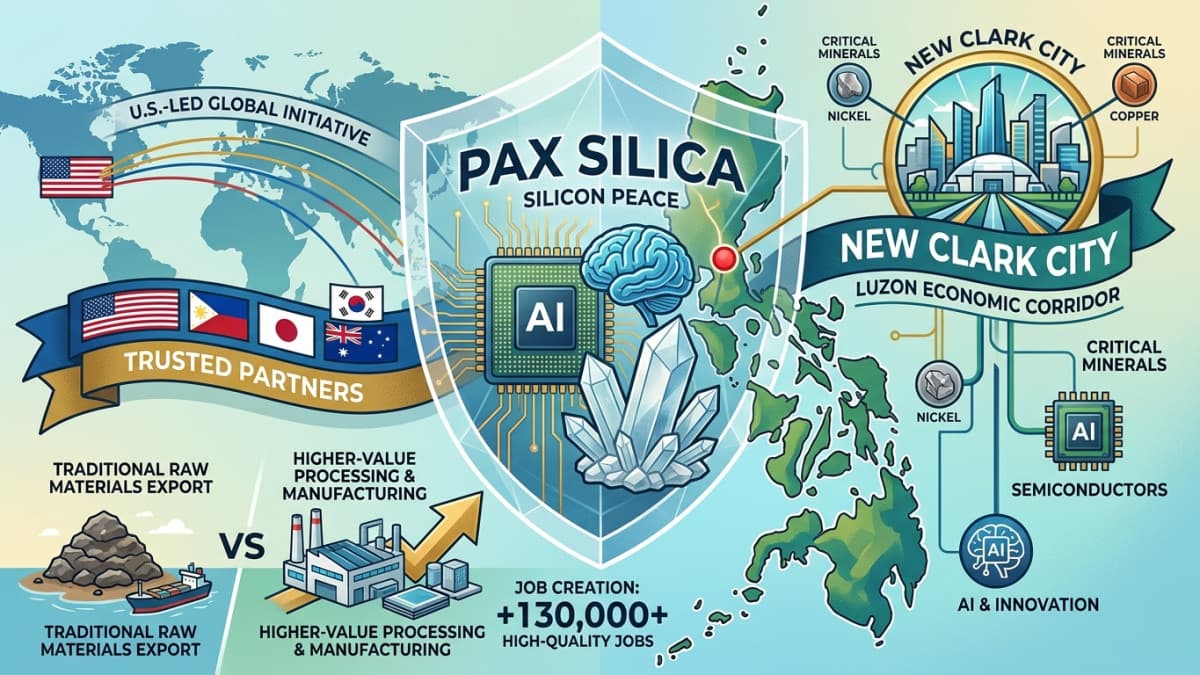
The headline project is a planned 1,620-hectare industrial complex in New Clark City. Its first 500-hectare phase could begin within three to five years, while full development is estimated to take 30 years. The $70-billion figure covers potential investments over that long horizon, not money already committed.
A ₱3.68-billion energy grant signed on the sidelines
The most concrete deal of the forum was signed on September 10: a $60-million (₱3.68 billion) grant agreement under the Millennium Challenge Corporation (MCC) Threshold Program, executed by Finance Secretary Go and Ambassador Lipton. The Department of Finance says the program will run for four years and nine months and has two main projects:
- PARE (Permitting and Approvals Reform for Efficiency) — streamlines government approvals so energy projects move faster and cost less to build.
- SURGE (Smart Utilities for Regional Growth in Energy) — digitalizes power grids, improves electric cooperative reliability, and helps mobilize financing for infrastructure.
A third component, the American Investment Mechanism (AIM) Project, funds feasibility studies and project preparation to draw in private capital. "This support will help us address key policy and institutional gaps to strengthen the foundations of our energy sector," Go said. Success would also strengthen the Philippines' case for a larger MCC Compact later on.
The partnership now includes the EU and Spain
SunStar reported that the corridor partnership expanded at the forum to include the European Union and Spain, joining Australia, Canada, Denmark, France, Italy, South Korea, Sweden, and the United Kingdom.
USTDA also announced funding for two Philippine-facing efforts: an expansion of ship repair facilities at Subic Bay, and pilots of AI-enhanced, US-made Wi-Fi access points at public sites across the country. Ambassador Lipton framed the event as "creating new opportunities for American companies and workers" while advancing prosperity in the Indo-Pacific.
Where Pax Silica fits
The corridor is the physical side of Pax Silica, the US-led initiative on securing supply chains for semiconductors, AI infrastructure, and critical minerals, which the Philippines joined in April 2026. The forum turns months of Pax Silica planning into an investment pipeline — from the coastal ecozones being lined up for AI data centers to the computing build-out targeted by the government's PAIIM masterplan.
Promises versus ground truth
The numbers deserve a careful read. Of the $70 billion (around ₱4.4 trillion) discussed, the items actually signed this week were the $60-million energy grant and USTDA's study and pilot funding — the rest is a projection spread over decades, and the 190,000 jobs figure depends on projects that have not broken ground. The first New Clark City phase alone is three to five years away. What matters next is which projects reach financial close, and how quickly the permitting reforms funded by PARE translate into shovels in the ground.