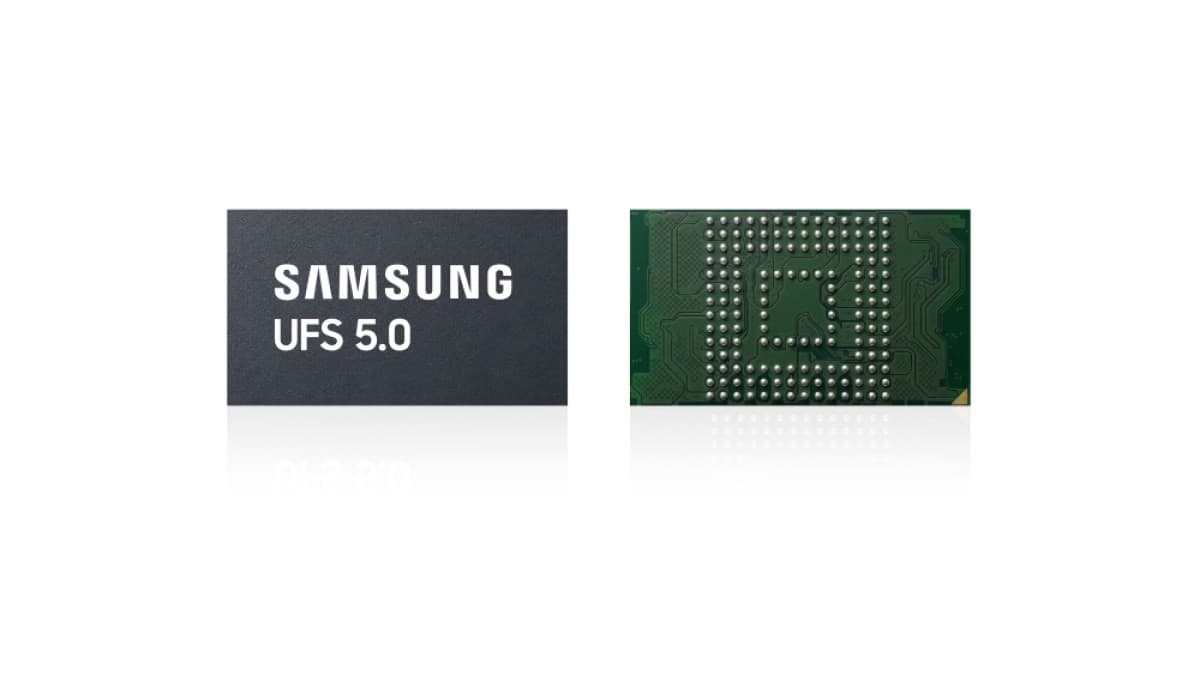
Samsung unveiled its UFS 5.0 storage solution on June 22, 2026, marking what the company calls the industry's fastest mobile flash storage to date. The new standard more than doubles the throughput of the UFS 4.1 chips found in today's flagship devices and cuts power draw by over 40% — a combination Samsung frames explicitly around the growing demands of on-device AI.
UFS 5.0 Specifications
The headline performance numbers:
- Sequential read speed: Up to 10.8 GB/s
- Sequential write speed: Up to 9.5 GB/s
- Speed vs. UFS 4.1: More than 2× faster on both read and write
- Power efficiency: Over 40% more efficient than UFS 4.1, via clock gating and multi-voltage innovations
- Capacity options: Up to 1TB
- Physical size: 7.5 × 13 × 0.9 mm — 16.7% smaller than the previous generation
The shrink in physical footprint is as relevant as the speed gains for devices like XR headsets and AI wearables, where board space is tightly constrained.
Built for On-Device AI Workloads
Samsung positions UFS 5.0 squarely at the AI inference use case. The company's memory division head stated: "Storage devices are evolving into a key driver defining AI experiences" in on-device environments — a framing that reflects how local AI models require fast, repeated reads of large parameter files, making storage throughput a genuine bottleneck rather than a background concern.
The 40% efficiency improvement matters as much as raw speed: high-throughput storage that drains the battery quickly would undermine the value of running inference locally. UFS 5.0 is designed to move data fast without the thermal or power penalty of the previous generation.
Galaxy S27 Expected to Debut UFS 5.0
Multiple industry reports point to the Samsung Galaxy S27 series as the first devices to ship with UFS 5.0. Qualcomm's Snapdragon 8 Elite Gen 6 — expected in the next wave of flagship Android hardware — has reportedly locked in UFS 5.0 support, per Wccftech. With mass production confirmed for Q4 2026, Galaxy S27 devices arriving in early 2027 are the natural launch vehicle.
A Generational Leap in the UFS Roadmap
UFS 4.0 arrived in 2022 and UFS 4.1 followed in 2024. The jump to UFS 5.0 is one of the largest performance leaps in the standard's history — comparable in magnitude to the step from UFS 2.1 to 3.0. For most consumers, the practical benefit will be most visible in AI feature responsiveness and large-file handling rather than general app performance, which is already limited less by storage speed than by compute.
Mass production begins Q4 2026. Devices equipped with UFS 5.0 are not expected to reach consumers until early 2027 at the earliest.