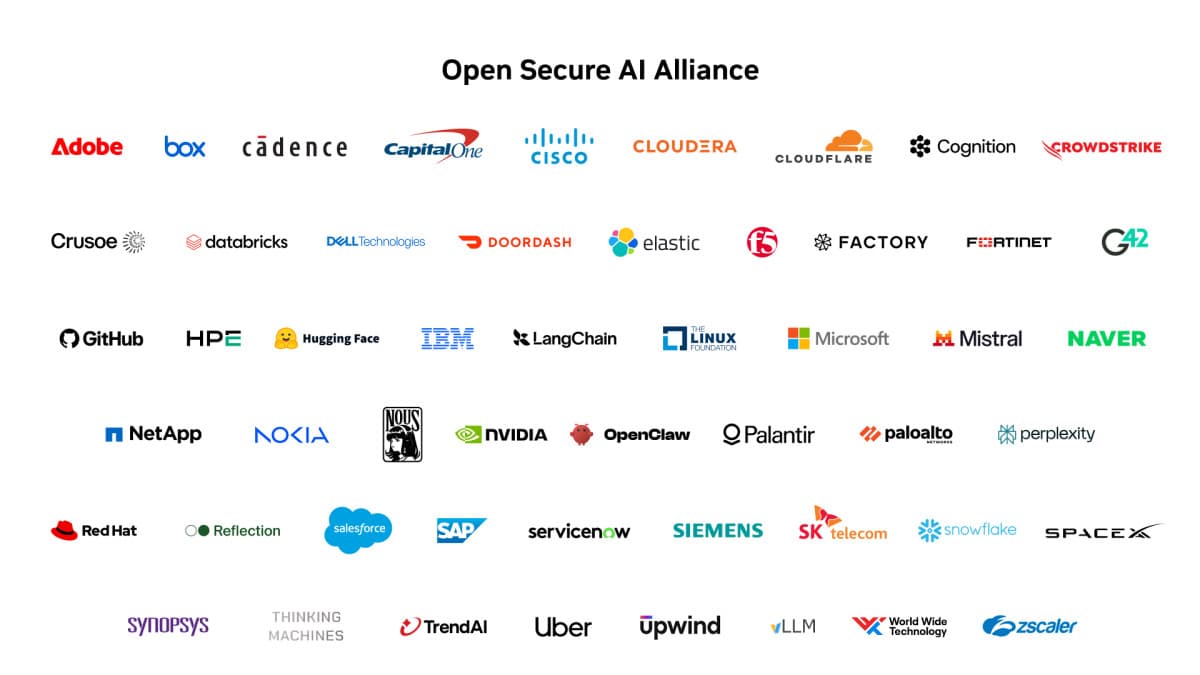
NVIDIA and a large group of technology, security, and enterprise software companies launched the Open Secure AI Alliance on July 27, an effort to build and give away the tooling needed to secure AI agents — the software that now acts on its own inside company systems.
The pitch is that AI security should not end up locked inside a handful of closed products. "Open source enables massively distributed community-driven and self-controlled defense – with no single point of failure," NVIDIA wrote in the announcement.
Who is in it — and how many
The membership list is broad: Microsoft, IBM, Red Hat, Cisco, CrowdStrike, Palo Alto Networks, Cloudflare, Fortinet, Zscaler, Hugging Face, Databricks, Dell Technologies, HPE, GitHub, Salesforce, SAP, ServiceNow, Siemens, Nokia, Snowflake, Uber, Adobe, Palantir, Mistral, Perplexity, LangChain, vLLM, and the Linux Foundation, among others.
The headcount is where reporting diverges, and it is worth being precise about. NVIDIA's own announcement page lists 70+ founding members. Engadget's report on the launch puts the figure at 27, and other early coverage cited 37. The most authoritative count is NVIDIA's, since it publishes the roster; the smaller numbers appear to reflect partial lists circulating as the announcement landed.
The alliance builds on existing work rather than starting fresh — specifically the Linux Foundation's Akrites initiative and the OpenSSF community.
What is actually being open-sourced
This is the substantive part, and several members are contributing real code rather than statements of support:
- NVIDIA — NOOA, short for NVIDIA Labs Object-Oriented Agent, a research framework that helps agent harnesses integrate with models so agent behaviour is easier to test, trace, audit, and govern. It is on GitHub.
- Hugging Face — Safetensors, a safe format for storing AI model weights.
- HPE — SPIFFE/SPIRE identity framework standards.
- IBM and Red Hat — Lightwell, for supply chain security using digitally signed patches.
- Microsoft — MDASH, a multi-model agentic scanning harness.
- SpaceXAI — the Grok Build terminal-based coding agent, with a stated plan to open-source Grok model weights.
The declared scope is what the alliance calls an "open defense stack for agents": identity and isolation, safe model formats, multi-model scanning, and secure coding workflows.
The argument for open models as defence
The alliance is also making a policy case. NVIDIA cited an incident in which closed AI tools — unable to tell an attacker from a defender — blocked forensic analysis outright, and Hugging Face had to run the open-weight GLM 5.2 model on its own infrastructure to analyse more than 17,000 actions and contain the intrusion.
The conclusion the group draws from that: regulators should treat open models as "defensive assets, not liabilities", and restrictions on open frontier systems "weaken defensive capacity and risk concentrating power". As NVIDIA framed the operational problem: "When defenders cannot inspect, adapt and run advanced AI on their own infrastructure, their ability to respond is constrained at exactly the moment speed matters most."
Why this lands hard in the Philippines
No Philippine organisation is a founding member, and none of these tools ship with local support. But the threat they target is already here in measurable volume.
Viettel Cyber Security counted 16,619 phishing attacks, 255 data breaches, and 21 ransomware incidents in the Philippines in the first half of 2026 alone, exposing around 335 million records and 19.2 million credentials, according to Gadgets Magazine. Finance, hospitality, logistics, manufacturing, and energy took the heaviest hits. The report's own framing is that AI "is no longer merely an emerging threat. It has become an operational tool increasingly used by cybercriminals."
Government is moving in the same direction the alliance is. The Department of Information and Communications Technology has built a cross-agency cyber defence alliance on Google Cloud's Cybershield covering 56 public agencies, and is rolling agentic AI into government platforms under DICT Secretary Henry Rhoel Aguda, as reported by GovInsider. That is the exact combination the Open Secure AI Alliance is written for: agencies deploying agents faster than the tooling to secure them exists. Free, inspectable defensive tools are worth more to an agency or a mid-sized Filipino company than to a bank that can buy whatever it wants — which is, in fairness, the alliance's own argument for existing.
What to watch
Open-sourcing a framework is the easy half. The test is adoption: whether NOOA, MDASH, and Lightwell end up inside the tools defenders actually run, or become well-funded repositories nobody deploys. Cloudflare, a founding member, has already been reworking how it controls AI agents and crawlers, which is the kind of shipped change that will show whether the alliance is doing more than issuing a press kit.