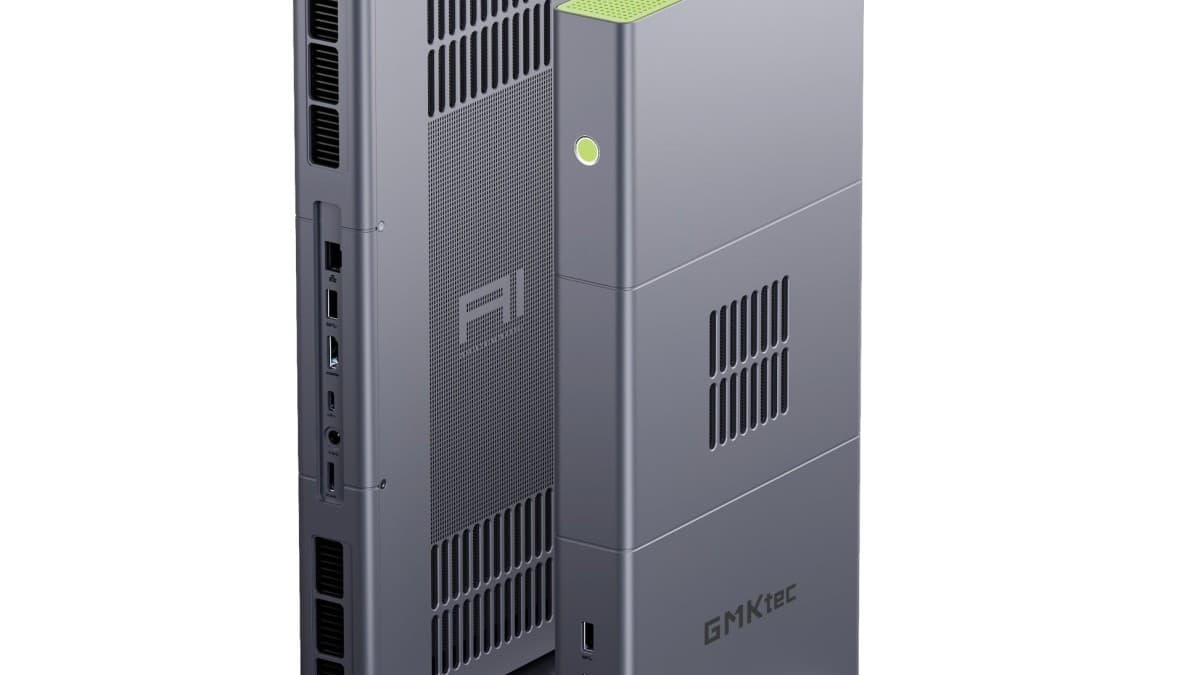
The GMKtec EVO-X3 is a mini PC built for one job: running large language models on your desk instead of in the cloud. It pairs AMD's flagship Ryzen AI Max+ 395 "Strix Halo" chip with 128GB of unified LPDDR5X memory and up to 126 TOPS of combined AI performance, enough to load models with as many as 235 billion parameters locally. It went on global sale on July 6, 2026, starting at $3,600 (around ₱221,000) for the 128GB + 2TB configuration.
Key Takeaways
- The EVO-X3 runs the AMD Ryzen AI Max+ 395 (16 Zen 5 cores, up to 5.1GHz) with a 50-TOPS XDNA 2 NPU and Radeon 8060S graphics.
- 128GB of onboard LPDDR5X-8000 memory (up to 96GB usable as VRAM) lets it run models up to 235 billion parameters locally.
- Pricing starts at $3,600 (around ₱221,000) for 128GB + 2TB and $3,849 (around ₱236,000) for 128GB + 4TB, with a regular price of $4,100 (around ₱252,000) after the launch window.
- It reuses the same APU as last year's EVO-X2 in a taller, PS4-sized tower — a redesign one outlet called a repackage at roughly double the price.
- There is no official Philippine distribution yet; local buyers would need to import the unit.
What the GMKtec EVO-X3 offers
At the center is the Ryzen AI Max+ 395, AMD's most powerful Strix Halo processor: 16 cores and 32 threads on the Zen 5 architecture, built on a TSMC 4nm process, boosting to 5.1GHz. Graphics come from an integrated Radeon 8060S with 40 RDNA 3.5 compute units — a GPU GMKtec pitches as delivering 1080p AAA gaming in the ballpark of a discrete RTX 4070. Feeding the AI workloads is a dedicated XDNA 2 NPU rated at 50 TOPS, comfortably above Microsoft's 40-TOPS floor for Copilot+ branding; combined CPU, GPU and NPU throughput is quoted at up to 126 TOPS.
The headline spec, though, is memory. The EVO-X3 ships with 128GB of soldered LPDDR5X running at 8000MT/s, of which up to 96GB can be allocated as VRAM for AI models. Storage runs through dual M.2 2280 PCIe 4.0 x4 slots, with 2TB or 4TB fitted out of the box and headroom for up to 16TB total. Connectivity is generous for a mini PC: a USB4 Type-C port (40Gbps, video out, 100W power delivery input), HDMI 2.1, a rear OCuLink port for external GPUs, 2.5G Ethernet, Wi-Fi 7 and Bluetooth 5.4.
Physically it breaks from the usual flat mini-PC box. The EVO-X3 is a tall, triple-fan tower wrapped in CNC-machined metal, measuring 353 x 186 x 41mm and weighing about 2.3kg, cooled by triple heat pipes and dual large fans across three power modes: Silent (54W), Balanced (85W) and Performance (up to 140W). It ships with Windows 11 Pro, supports Ubuntu and Linux, and bundles GMKtec's Claw local-AI toolkit for one-click model deployment.
EVO-X3 configurations and pricing
| Configuration | Price (USD) | Approx. peso |
|---|
| 128GB RAM + 2TB SSD | $3,600 (launch) | around ₱221,000 |
| 128GB RAM + 4TB SSD | $3,849 (launch) | around ₱236,000 |
| Regular price (post-launch) | $4,100 | around ₱252,000 |
Conversions use a rate of roughly ₱61.4 to the dollar; the peso figures are approximate and will shift with the exchange rate and any import costs.
Running 235B-parameter models locally
The whole point of that 128GB pool is keeping big models off the cloud. With up to 96GB addressable as VRAM, GMKtec says the EVO-X3 can load models as large as Qwen3 235B and run them locally through its bundled Claw manager — the kind of workload that normally demands a multi-GPU workstation or a paid API subscription. For developers, researchers and creators experimenting with local inference, a single low-power box that never sends prompts to a third party is the pitch. That fits a broader industry shift toward putting AI to work closer to the user, alongside the enterprise push behind projects like Microsoft's Frontier AI unit.
A familiar chip in a pricier new shell
The EVO-X3's value is not universally accepted. It carries the same Ryzen AI Max+ 395 APU as GMKtec's earlier EVO-X2, meaning the raw compute is largely unchanged year over year. Notebookcheck framed the EVO-X3 as a "repackaged" Strix Halo mini PC selling at roughly double the EVO-X2's launch price for identical memory and storage tiers — with the tangible upgrades being the tower chassis, the added OCuLink port, Wi-Fi 7 and the higher 140W power ceiling rather than a new processor. Whether those refinements justify the jump depends heavily on how much a buyer values the redesign and expandability over the older, flatter model that used the same silicon.
Why It Matters for PH buyers
There is no official GMKtec Philippine distribution, so anyone here would import the EVO-X3 and shoulder shipping and possible duties on top of the roughly ₱221,000 starting price — squarely a niche buy for AI developers and studios rather than a mainstream mini PC. Its appeal locally comes down to a simple trade: a one-time hardware cost against recurring cloud-inference fees, in a compact machine that keeps sensitive data and prompts on-premises. For most users a far cheaper mini PC will do, but for the small group running large models locally, few desktop-class boxes offer this much memory in this footprint.