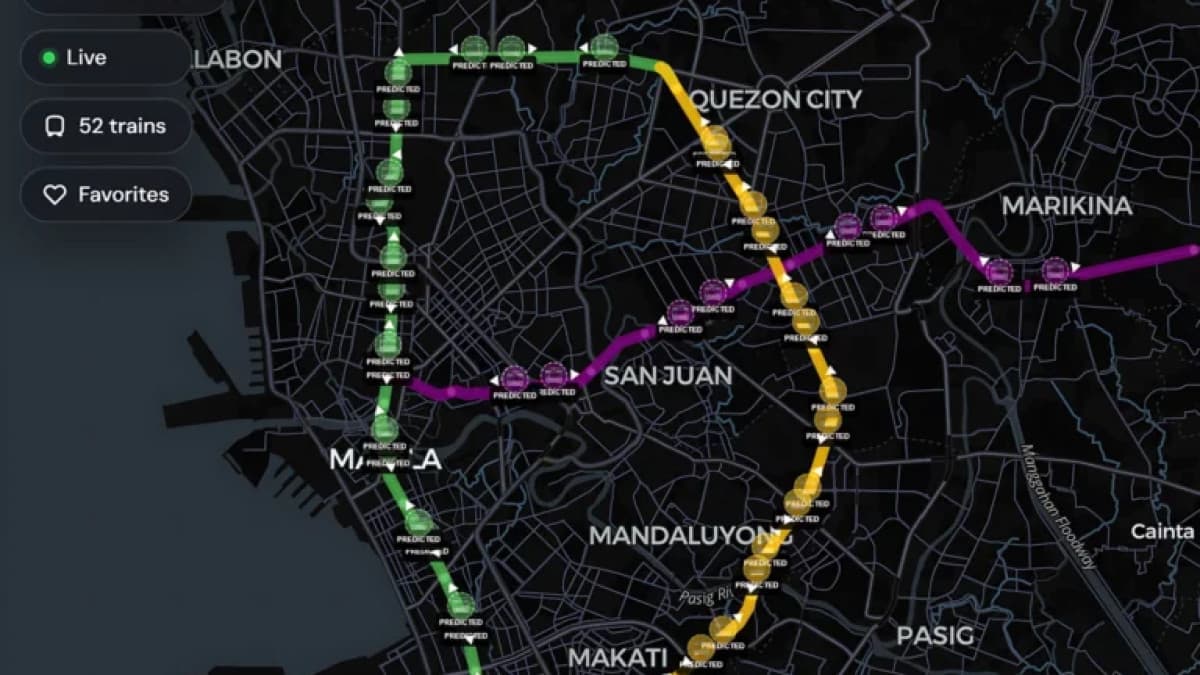
A delayed LRT-1 ride is a familiar Metro Manila experience. You stand on the platform, the crowd thickens, and nobody can tell you whether the next train is two minutes away or twenty. TrainSight, a real-time train tracker built by a Filipino software engineer, is an attempt to answer that question with live data instead of guesswork.
The platform tracks trains on LRT-1, LRT-2 and MRT-3, with support for MRT-7 planned. It is already usable in two forms: a web version at the TrainSight live map, and a beta Android build that has to be sideloaded (installed manually, outside the Play Store).
Who built it, and why
TrainSight is the work of RJ Crusem, a 28-year-old software engineer from Cavite. The idea came from his own commute — one delayed LRT-1 trip was enough to convince him that passengers deserved to know where their train actually was. He has said the model he had in mind was FlightRadar24, the service that shows aircraft moving across a map in near real time.
That framing matters, because it sets the bar. Flight trackers work because aircraft continuously broadcast their position. Philippine rail has no equivalent public feed, so TrainSight has to build one.
How a crowdsourced train tracker works
TrainSight combines two data sources. The first is crowdsourced device location: when a commuter uses the app while riding, their phone's movement helps the system infer where that train is. The second is hardware trackers fitted to trainsets, which would give the platform a direct position signal rather than an inferred one.
On top of the live positions, the TrainSight app layers a few things a commuter actually uses:
- Live train positions on a map of the line
- Arrival and departure alerts for stations you mark as favourites
- Predicted schedules derived from official LRT and MRT timetables
- Active service alerts when something goes wrong on a line
- Custom alert timing, with sound, voice announcements, or vibration
On privacy, the project states that location data is used only to calculate train positions and is not stored in its database — a reasonable thing to check, since the whole model depends on riders sharing where they are.
Where the data still has gaps
It is worth being clear about the stage this is at. TrainSight's own site currently reports coverage of 3+ routes and 52+ contributing commuters, alongside a claimed 99.2% uptime and a REST API (a way for other apps to pull the same data) aimed at wider mobility platforms.
Fifty-two contributors is a small sample for three lines that move hundreds of thousands of people a day. Crowdsourced tracking gets sharper as more riders join, so early users should expect thin coverage at off-peak hours and on the stretches where few people are running the app. The hardware trackers are the fix for that, but they need the rail operators to cooperate — and no operator agreement has been announced.
When you can install it
The rollout is staged:
- Now — web at
rail.trainsight.app, plus a sideloadable Android beta - August 2026 — Google Play Store release
- September to October 2026 — Apple App Store release
Crusem has also said he wants to extend coverage beyond rail to buses and other public transport.
What a live train map would change for commuters
The practical value is not novelty, it is decision-making. Knowing a train is stalled two stations up lets you leave the queue and take a bus or a jeep instead of losing forty minutes on a platform. That is the same kind of shift Metro Manila commuters have seen from other digital transport services, including contactless fare payments now live across LRT-2 and MMDA traffic fines moving onto the eGovPH app.
There is a second effect the developer has pointed to: accountability. If train movement is publicly visible, delays become a matter of record rather than a matter of complaint. Whether that visibility is welcomed by operators is a separate question, and one the project has not answered yet.
For now, TrainSight is a well-scoped independent project rather than an official service. It is not affiliated with LRTA, DOTr, or the MRT-3 management, and its accuracy will rise or fall on how many commuters actually run it.