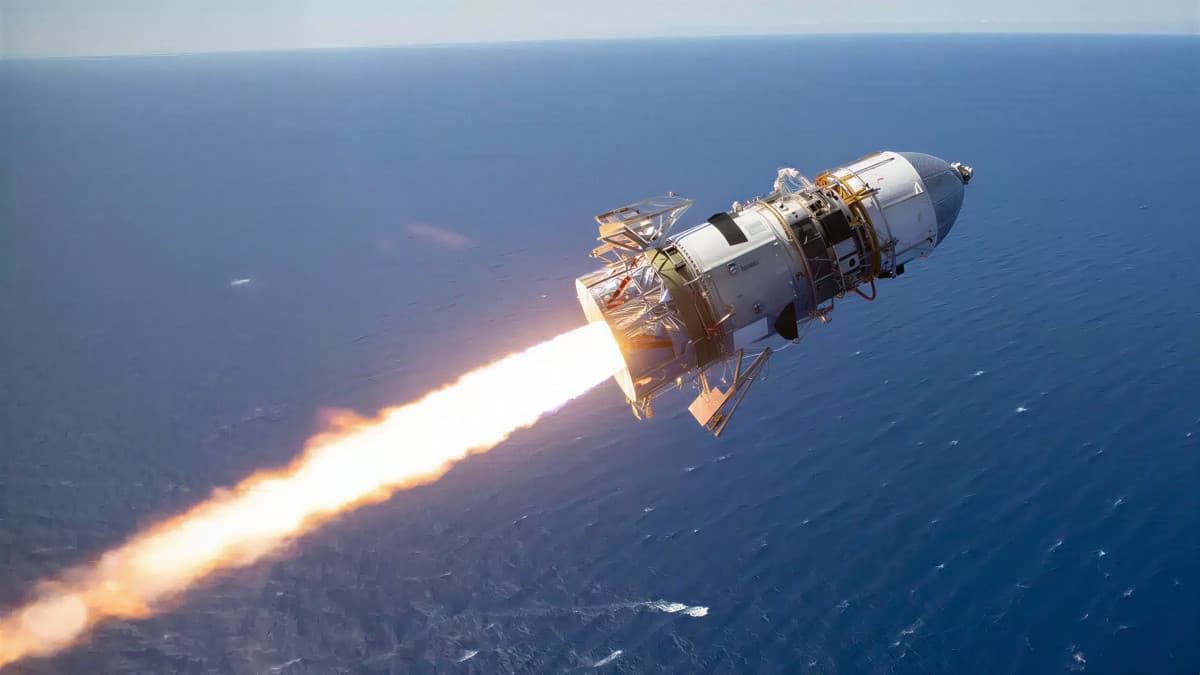
SpaceX put the first V3 Starlink satellites into orbit on Starship's thirteenth test flight, lifting off from Starbase in Texas at 5:51 p.m. Central on July 24 — early Saturday morning, July 25, Philippine time. Twenty of the new satellites were deployed during the roughly hour-long flight, which ended with the upper stage settling intact into the Indian Ocean.
It was the second flight of the V3 version of Starship and Super Heavy, the 407-foot vehicle SpaceX is building to replace the Falcon 9 for heavy payloads.
How Flight 13 went
All 33 Raptor 3 engines lit on the Super Heavy booster. After hot-staging — where the upper stage fires its own engines while still attached to the booster — Starship completed its full ascent burn and reached its planned velocity.
The deployment worked. Engineers made contact with all 20 satellites and pulled data from each one within about 20 minutes, Broadband Breakfast reported. Six of the satellites carried cameras pointed at the spacecraft's heat shield, including deliberately unpainted tiles flown to see how much heat they could take.
Starship then relit all three of its landing engines, performed the flip-and-burn manoeuvre, and came to rest floating and intact — the first time SpaceX has had a clear post-splashdown look at the heat shield. "We got all the heat shield data we needed and then some," Elon Musk said. A SpaceX engineer on the broadcast called it "lucky flight 13."
The booster is still the hard part
The Super Heavy booster did not fare as well. Its burn ended early and not enough engines relit for the simulated landing, so it came down hard in the Gulf. SpaceX had already replaced six of the booster's 33 engines after an aborted attempt the week before, and the flight had been pushed back again by Tropical Storm Bertha.
Reusing the booster is central to Starship's economics. Until the landing burn is reliable, each flight still consumes hardware SpaceX intends to fly many times over.
Why the V3 Starlink satellites matter more than the rocket
For anyone who uses satellite internet, the payload is the bigger story. The V3 satellites carry more than 10 times the downlink and 24 times the uplink capacity of the second-generation units now doing most of the work — a large jump in how much traffic a single satellite can carry.
That capacity only reaches orbit at scale on Starship. A fully loaded Starship flight could add on the order of 60 terabits per second of capacity, more than twenty times what SpaceX can loft on a current launch. The company already operates over 10,000 Starlink satellites, the largest constellation in orbit.
What this means for Philippine users
Starlink is not an abstraction here. Globe launched Starlink satellite-to-mobile service in the Philippines — the first in Southeast Asia — and the DICT welcomed the partnership as a way to connect unserved areas without building cell towers. Cebu Pacific has also committed to Starlink inflight Wi-Fi from 2027.
Capacity is the constraint that decides how good those services feel in daily use. An archipelago with thousands of islands and patchy fibre is exactly the kind of market where per-satellite capacity translates into whether a video call from a remote barangay holds up. More capable satellites overhead should ease that ceiling over time.
The honest caveat: SpaceX has not announced a Philippine-specific timetable for V3 coverage, and no local pricing change has been tied to it. Flight 13 proves the satellites can be deployed, not that they are already serving anyone here.