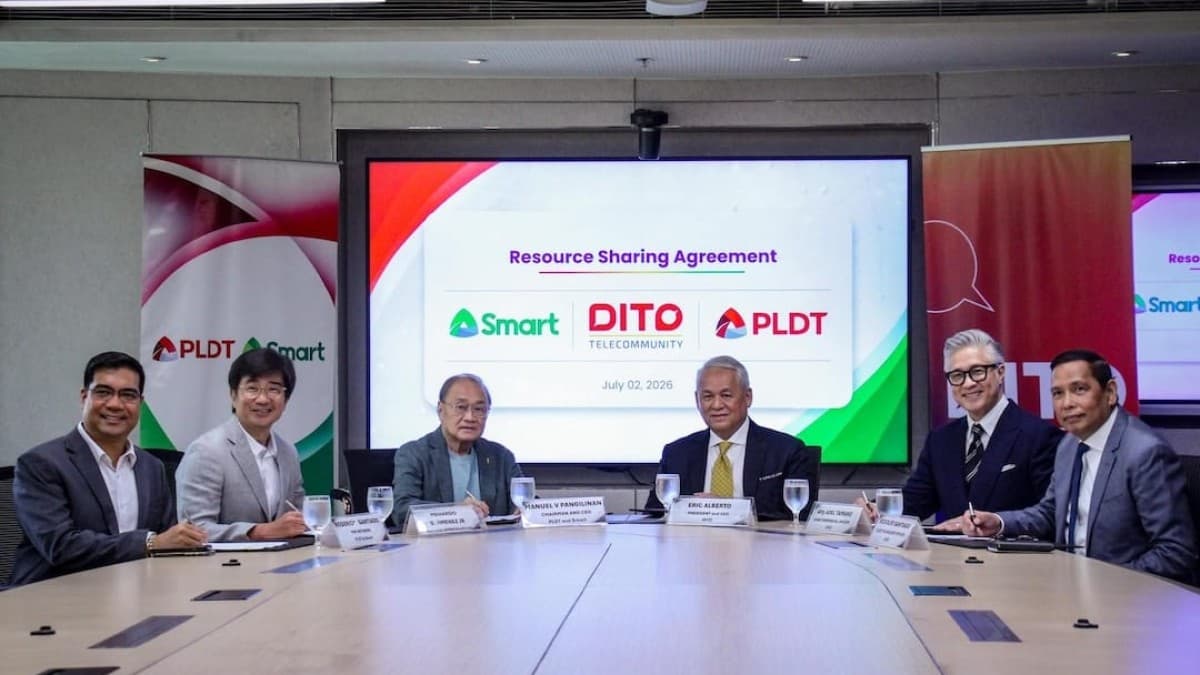
The country's three biggest mobile networks are setting rivalry aside to build out coverage together. On July 3, 2026, PLDT Inc., its wireless arm Smart Communications, and DITO Telecommunity signed a memorandum of understanding to share cell towers, in-building facilities, and international submarine cable capacity — a first-of-its-kind arrangement that both camps described as landmark, and one that comes with no money changing hands between the parties.
Key Takeaways
- PLDT, Smart, and DITO signed an infrastructure-sharing memorandum of understanding on July 3, 2026.
- It grants reciprocal access to eligible macro tower sites, co-location of in-building facilities, and submarine cable capacity via Indefeasible Right of Use (IRU) arrangements.
- No monetary compensation is exchanged — the telcos swap access to resources rather than pay one another.
- It is DITO's first infrastructure-sharing agreement with a rival mobile operator, per BusinessWorld.
- The stated goals are to cut duplicated capital spending, speed up deployment, and widen mobile and 5G coverage nationwide.
What the three telcos agreed to
According to TechSabado and corroborating reports from the Philippine News Agency and BusinessWorld, the agreement spans three concrete areas. The companies grant one another reciprocal rights to use eligible macro tower sites; they will co-locate equipment in commercial buildings and other indoor facilities through in-building solutions; and they will share international submarine cable capacity under Indefeasible Right of Use (IRU) agreements — the long-term capacity leases that carriers typically use to trade access to undersea fiber.
Crucially, the arrangement is non-monetary. As BusinessWorld and the Philippine News Agency both reported, PLDT, Smart, and DITO will share towers, indoor network facilities, and submarine cable capacity instead of billing one another fees. In practice, that means each network can light up service in areas where a rival already has a tower or a building installation, without waiting to build its own.
Why infrastructure sharing matters
Building cell sites is slow and expensive, and duplicating towers across three networks in the same barangay is capital that could be spent extending coverage to unserved areas instead. By pooling passive infrastructure, the operators aim to maximize existing sites, reduce capital-expenditure duplication, accelerate rollout, improve reliability, and expand mobile coverage — the strategic objectives laid out in the announcement. The deal also arrives as operators across the region look to trim network costs while pushing 5G further out.
It is a notable step for DITO in particular. BusinessWorld characterized the memorandum as DITO Telecommunity's first infrastructure-sharing agreement with a rival mobile operator — a meaningful shift for the third player, which has been racing to close the coverage gap with the two incumbents since its commercial launch.
What the executives said
PLDT Chairman and CEO Manuel V. Pangilinan framed the deal as collaboration that coexists with competition. "Connecting the country is a responsibility that we all share as Philippine telcos," he said in remarks carried by TechSabado. "This agreement reflects that, even as we compete in the marketplace, we can collaborate where it matters the most: accelerating digital inclusion, helping connect every Filipino, and creating greater opportunities for our people and our nation."
DITO Telecommunity President and CEO Eric Alberto struck a similar note, calling the partnership "a modest one" that "allows both companies to deliver much better services for all our respective customers."
The bigger picture
The move fits a broader shift in how Philippine carriers are investing. Rather than each network racing to blanket the same neighborhoods with parallel towers, sharing passive infrastructure lets them stretch capital further — echoing the logic behind other recent connectivity pushes such as Globe's Starlink satellite-to-mobile rollout. As of publication, the parties have not disclosed specific coverage-expansion figures or a timeline for when subscribers will notice improvements, so the real test will be how quickly the shared sites translate into stronger signal in the field.
Still, an agreement that has all three national networks trading access to towers and undersea cables — without invoices — is an unusually cooperative moment in an industry defined by hard competition, and one that could reshape how fast connectivity reaches the country's harder-to-serve areas.
Sources: