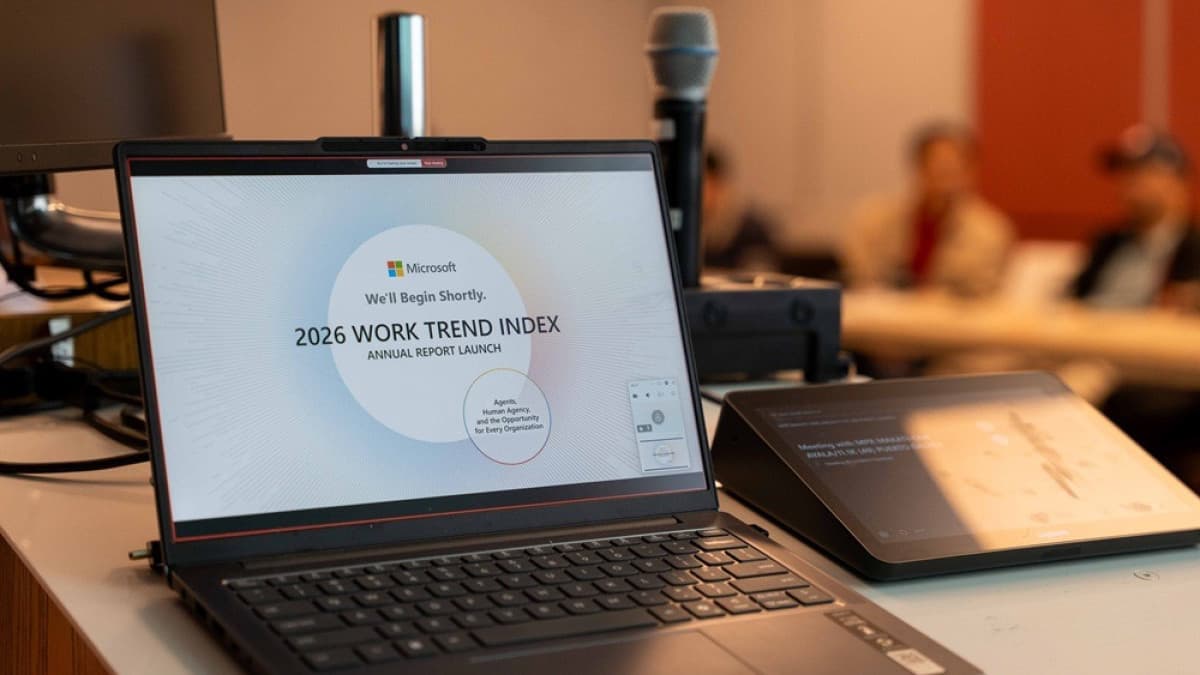
One in four Filipino workers who use AI on the job now ranks among the world's most advanced users, according to Microsoft's 2026 Work Trend Index — but the companies they work for are struggling to keep up. The report, titled "Agents, human agency and the opportunity for every organization," classifies 25% of Filipino AI users as Frontier Professionals, well above the global average of 16%.
Frontier Professionals, as Microsoft's report defines them, are workers who use AI agents for complex, multi-step work, redesign their workflows around what AI does well, and follow structured, repeatable AI practices — while keeping human judgment in charge.
How far ahead Filipino workers are
The global study surveyed 20,000 full-time knowledge workers who use AI at work across 10 countries between February 18 and April 7, 2026, with research conducted by Edelman Data x Intelligence; the Philippine figures come from additional research Microsoft ran alongside the core survey. Among the local findings:
- 77% of Filipino AI users say they now produce work they could not have produced a year ago, versus 58% globally. Among Filipino Frontier Professionals, that rises to 86%.
- 65% name critical thinking as the most important human skill in the AI era, against 46% globally.
- 93% treat AI output as a starting point rather than a finished product, and 59% prioritize quality control of what AI produces.
- 53% of Filipino Frontier Professionals deliberately work without AI at times to keep their own skills sharp.
"The Philippines is ready for AI. Not catching up — ready and ahead of the world on the measures that matter the most," said Josh Aquino, head of communications at Microsoft Philippines, who added that the discipline of advanced users is "not hesitancy" but deliberate practice.
The catch for Philippine companies
The same data exposes what the report calls a Transformation Paradox: workers are changing faster than the systems around them. Only 35% of Filipino AI users say their leadership is aligned on AI, just 25% are rewarded for reinventing how they work (versus 13% globally), and 53% still feel it is safer to focus on current priorities than to redesign their work around AI. Microsoft attributes 67% of AI's impact to organizational factors — culture, manager support, talent practices — and only about a third to individual mindset. In short: Filipino workers have gone further than their employers' playbooks.
Early local deployments show what closing that gap looks like. Coverage of the report's Philippine launch notes that PLDT and Smart have rolled out 1,000 Microsoft 365 Copilot seats, while a Department of Education pilot of Reading Progress in Bais City cut reading assessments from two days to two hours, saving teachers around nine hours a week. Usage of AI agents, meanwhile, grew 15-fold year-on-year, and 18-fold among large enterprises.
Managers are the multiplier
The report is unusually specific about where the difference comes from: direct managers. Compared with other AI users, Frontier Professionals are far more likely to have managers who openly use AI themselves (85% versus 64%), set quality standards for AI-assisted work (83% versus 57%), create room to experiment (84% versus 61%), and encourage redesigning work around AI (87% versus 61%). A companion analysis of 1,800 workers by Microsoft People Science found that when managers actively model AI use, perceived value of AI rises by 17 points, critical thinking about AI output by 22 points, and trust in agentic AI — AI that can carry out multi-step tasks on its own — by 30 points. As Aquino put it: "None of these require new technology. They require decisions."
The findings track with other recent signals of Filipino AI enthusiasm, from Gemini adoption doubling across Southeast Asia with the Philippines leading female AI uptake to PLDT and Smart shipping their own agentic AI tools. The report's message to local executives is blunt: the workforce is not the bottleneck. Sixty-six percent of Filipino AI users already worry about falling behind if they fail to adapt — the question is whether their organizations will reward them for moving.