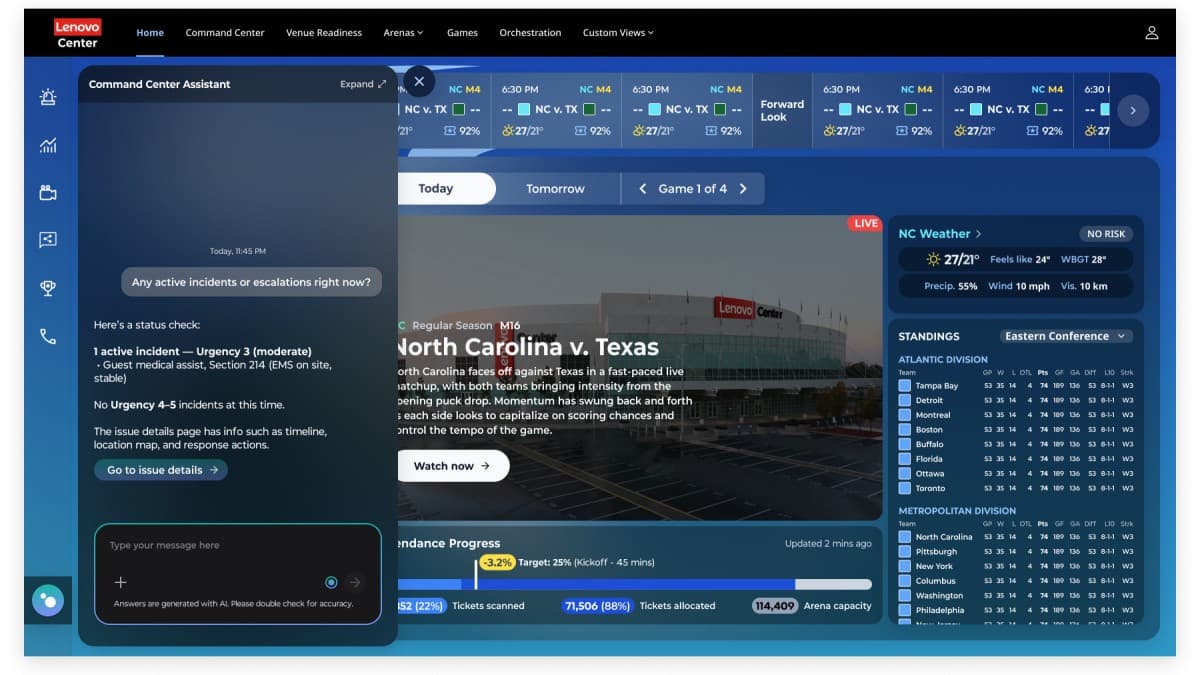
Lenovo has built an Intelligent Command Center (ICC) — a single, real-time dashboard that lets FIFA run the entire 2026 World Cup from one room in Miami. As the Official Technology Partner of the FIFA World Cup 2026, Lenovo designed the platform to manage the biggest tournament in the event's history: 48 teams, 104 matches, 16 host cities, and three countries (the United States, Canada, and Mexico). With the final set for July 19 at MetLife Stadium near New York, the command center is running live right now.
What the Intelligent Command Center does
The ICC is a centralized operations platform. It pulls data from many separate systems into one live view, so FIFA officials look at the same picture at the same time — from what is happening inside a single stadium to trends across the whole tournament. In Lenovo's own description, it is a "holistic, live view of everything happening across the tournament."
The platform lives inside FIFA's Tournament Operations Center (TOC) in Miami, the room from which FIFA oversees the whole competition. Large screens show real-time insights and alerts, while authorized staff can pull up the same information on Lenovo tablets wherever they are.
Running an event across three countries and 16 stadiums is a huge logistics job. Older tournaments relied on separate, siloed systems, which meant teams often worked from fragmented information. By putting stadium operations, security, transport, and logistics data in one place, the ICC helps FIFA spot bottlenecks, risks, and disruptions earlier and respond faster. It also supports scenario planning before matches and reviews after them.
The hardware behind the biggest World Cup ever
The command center sits on top of a much larger Lenovo rollout that covers both operations and the broadcast. (For the full picture of the device fleet and the tournament's AI tools, see our earlier report on Lenovo's World Cup 2026 technology deployment.)
The headline numbers, reported by TV Technology, are:
- Lenovo ThinkSystem SR635 V3 servers ingest, process, and distribute live match content across 10 channels to more than 1,000 screens inside FIFA venues.
- IPTV latency under five seconds. IPTV (Internet Protocol Television, which sends video over the internet instead of cable or satellite) usually lags well behind live. Cutting it to under five seconds means near-real-time viewing.
- More than 17,000 Lenovo and Motorola devices are deployed across venues and the Team Base Camp training sites.
- Over 200 engineers support the setup.
- Two hubs anchor it all: a FIFA Technology Command Center and the Tournament Operation Center that watches all 16 venues in near-real-time.
"Lenovo's AI infrastructure is redefining the FIFA World Cup experience, delivering near real-time highlights, multi-angle views and insights at unprecedented global scale," said Ashley Gorakhpurwalla, president of infrastructure solutions at Lenovo.
The AI running on the pitch and in the broadcast
The same infrastructure feeds a set of AI tools. Lenovo's global CIO Arthur Hu told InformationWeek that the aim is practical help, not gimmicks. The main pieces:
- An AI tactical assistant for all 48 teams, giving coaches and analysts quick insights (covered in depth in the earlier report linked above).
- Stabilized referee views, where first-person referee camera footage is smoothed by AI — up to 50% less motion distortion — so it is watchable rather than dizzying.
- 3D player avatars that make offside calls easier to see.
- AI-driven navigation to ease crowding around venues.
Lenovo says the broadcast pipeline is built to reach an audience it counts in the billions worldwide.
How Filipinos can watch the FIFA World Cup 2026
The command center is a FIFA-internal tool, so it is not a product you can buy in the Philippines — no local pricing or availability has been announced, and none is expected, because it is not sold to the public. What Filipino fans get from all this technology is faster, more synchronized coverage.
For watching the matches themselves, Rappler reports several local options:
- BlastTV and Pilipinas Live each offer all 104 matches for ₱1,999 for the whole tournament, streamable on phones, tablets, and smart TVs.
- Aleph Arena is streaming 40 matches for free on its YouTube channel, with the July 19 final expected to be included.
- TAP carries matches on Cignal Play, TapGO TV, and dedicated World Cup TV channels.
What the command center means for fans here
The ICC is not something Filipino buyers will ever touch, and it will not appear in local stores. Its value for someone streaming from Manila or Cebu is indirect: the sub-five-second IPTV pipeline it sits on is the reason highlights, multi-angle replays, and near-live feeds can reach screens quickly. In plain terms, the smoother and more in-sync your stream feels compared with past tournaments, the more of that traces back to this kind of back-end setup. The devices doing the heavy lifting — Lenovo servers and Motorola phones — are brands already sold across the Philippines, even if this specific deployment is North America only.
FAQ
When is the FIFA World Cup 2026 final?
The final is on July 19, 2026 at MetLife Stadium in East Rutherford, New Jersey, near New York, a venue that seats more than 82,000, according to the stadium.
Where can Filipinos watch the World Cup 2026?
BlastTV and Pilipinas Live carry all 104 matches for ₱1,999 for the tournament, Aleph Arena streams 40 matches free on YouTube, and TAP airs games on Cignal Play and its World Cup TV channels.
Can you buy Lenovo's Intelligent Command Center?
No. It is a private operations platform built for FIFA's staff, not a consumer product, so there is no Philippine price or release.