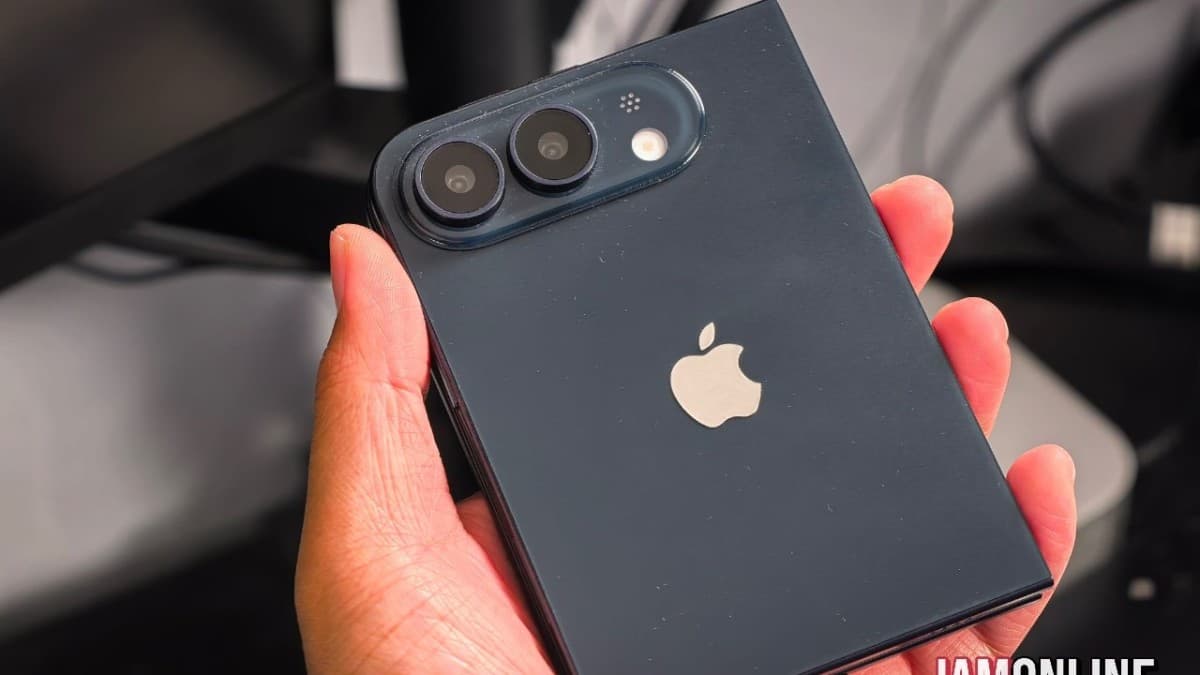
The iPhone 18 Fold is still months away from its official announcement, but a non-functional dummy unit has made the rounds, offering the clearest look yet at Apple’s first foldable smartphone. Jam Ancheta of JAM Online put the prototype through its paces on June 29, 2026 — and the verdict is clear: this thing feels very different from any iPhone that has come before it.
Key Takeaways
- The iPhone 18 Fold prototype is not functional — it’s a dummy unit used for case-making and early hands-on assessment.
- When folded, the device is noticeably wider than any current iPhone, resembling a portrait-mode iPad mini.
- Unfolded, the inner display feels more like a compact tablet than a phone.
- Dual cameras on the back, plus two front-facing cameras — one on each display.
- USB-C, Camera Control button, and a power button are confirmed hardware details.
- Expected to launch alongside the iPhone 18 Pro and iPhone 18 Pro Max in fall 2026.
A Wide, Unusual Form Factor — By Design
The most striking thing about the iPhone 18 Fold is its proportions. Where Samsung’s Galaxy Z Fold series goes tall and narrow when closed, Apple has gone in the opposite direction: the folded iPhone 18 Fold is wide and short, roughly comparable to a BlackBerry Passport but without the physical keyboard and with a smaller overall footprint.
This unusual aspect ratio is a deliberate design choice. Apple appears to be prioritizing the unfolded, inner-screen experience over traditional single-handed smartphone ergonomics. The trade-off: operating the device with one hand while folded is noticeably more challenging than using a standard iPhone, simply because the device is so wide.
Closed, it genuinely resembles “a smaller iPad mini being used in portrait orientation,” as JAM Online’s review put it. That framing is apt — and it hints at how Apple likely sees this device: not as a premium smartphone that also unfolds, but as a compact tablet that also folds shut.
Unfolded: More Mini iPad Than Phone
Open the iPhone 18 Fold and the tablet analogy sharpens. The inner display is wide rather than tall, which immediately differentiates it from the experience of unfolding a Galaxy Z Fold. Rather than just stretching a tall phone horizontally, you’re looking at a landscape-oriented surface that feels natural for multitasking, media, and reading.
For context, early iOS 27 beta code has already pointed to an Apple foldable device, suggesting the software has been in development alongside the hardware for some time.
Cameras: Dual Rear, Dual Front
The prototype reveals a dual-camera system on the back — a significant step back from the triple-camera array on the iPhone 18 Pro Max, though reasonable for a first-generation foldable where chassis thickness is a primary concern.
Perhaps the more interesting discovery is the dual front-facing cameras. One sits at the top center of the outer (cover) display, and a second appears in the upper-left area of the inner foldable screen. Both cover-screen and inner-screen selfies and FaceTime calls are covered, which is important for a device that users may want to use in both folded and unfolded configurations.
Hardware Details Confirmed by the Prototype
Despite being a non-functional unit, several hardware decisions are already locked in:
- USB-C port at the bottom, between speaker grilles — Apple is not going portless with the Fold.
- Camera Control button is present, positioned with the power button above it on the right edge.
- Volume buttons sit unusually high on the left side, a placement that some early reviewers found counterintuitive.
- The device is described as thin and solid in hand, consistent with Apple’s typical build quality even at the prototype stage.
What We Still Don’t Know
The dummy unit, by definition, tells us nothing about the display quality, the chip inside, the hinge mechanism, whether there’s a visible crease on the inner screen, battery life, or pricing. Apple has not officially acknowledged the iPhone 18 Fold’s existence, and all of the above remains in the realm of rumor and speculation.
MacRumors’ ongoing roundup on the iPhone Fold lists the device as part of the fall 2026 iPhone lineup, expected to debut alongside the iPhone 18 Pro and iPhone 18 Pro Max at Apple’s usual September event. Pricing for a first-generation flagship foldable is likely to land well above any existing iPhone — Samsung’s current Galaxy Z Fold series starts at over $1,800 (~₱110,000).
FAQ
When will Apple officially announce the iPhone 18 Fold?
Apple has not announced any such device. Based on the prototype leak and analyst reports, it is expected as part of the fall 2026 iPhone lineup — most likely at Apple’s September 2026 event alongside the iPhone 18 Pro models.
How much will the iPhone 18 Fold cost in the Philippines?
No official price has been announced. Apple has not confirmed the device exists. For reference, Samsung’s current foldable flagship starts above ₱110,000, and Apple’s premium products tend to command similar or higher pricing in the Philippine market.
Will it have Face ID?
The prototype does not reveal internal components. Given Apple’s commitment to Face ID and its absence of under-display fingerprint sensors in the current lineup, Face ID remains the most likely biometric — though the exact implementation on a device with two displays is unclear.
Sources: